
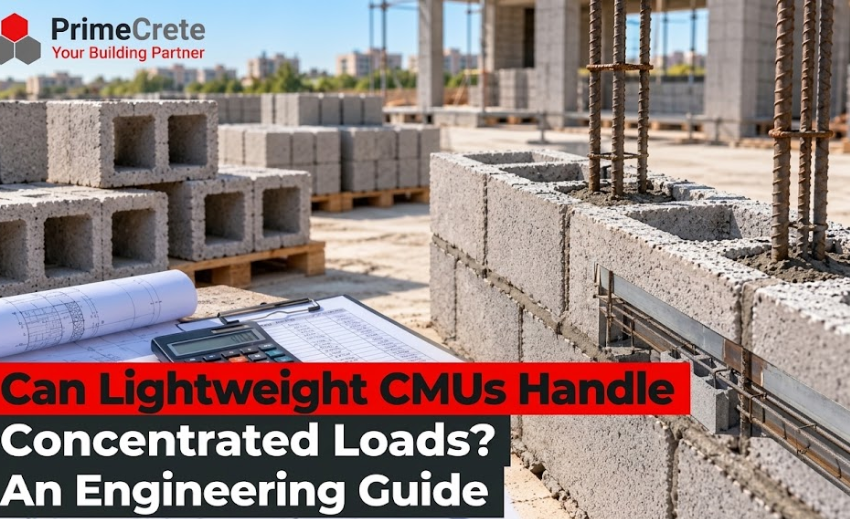
When designing commercial or residential structural masonry, one question frequently divides site engineers and contractors across Pakistan: can lightweight CMUs handle heavy concentrated loads without crushing or cracking? The short answer is yes-provided the wall assembly is engineered to transfer localized stresses safely into the masonry system.
At PrimeCrete, our German-engineered Masa batching technology produces high-performance lightweight CMUs designed to satisfy structural loadbearing benchmarks. While conventional wisdom in Pakistan often defaults to heavy solid clay bricks (Awwal bricks) or dense cast-in-place concrete under heavy steel beams, modern lightweight concrete masonry units deliver equal net compressive capacity while cutting structural dead weight by up to 40%.
However, handling concentrated point loads requires understanding the difference between uniform wall loading and localized bearing stress. Here is the complete engineering breakdown of how lightweight CMUs behave under point loads, where the failure risks lie, and how to detail them correctly for construction projects in Pakistan.
Distributed Loads vs. Concentrated Loads: Understanding the Mechanics
To evaluate point-load tolerance, it is crucial to distinguish load types:
- Uniform Distributed Loads (w): Gravity loads spread evenly across the top plane of the wall, such as continuous precast planks or cast-in-place RCC slabs. In our guide on whether lightweight CMUs can support roof loads, we detailed how continuous bond beams distribute these stresses evenly across the entire wall footprint.
- Concentrated Loads (P): High-magnitude forces applied over a very small, localized surface area. Typical examples on Pakistani industrial and commercial job sites include:
- Structural steel I-beams (universal beams/columns) resting directly on masonry.
- Heavy roof trusses and open-web steel joists.
- Precast concrete girders and lintel end-reactions.
- Crane rail support brackets and mezzanine ledger angles.
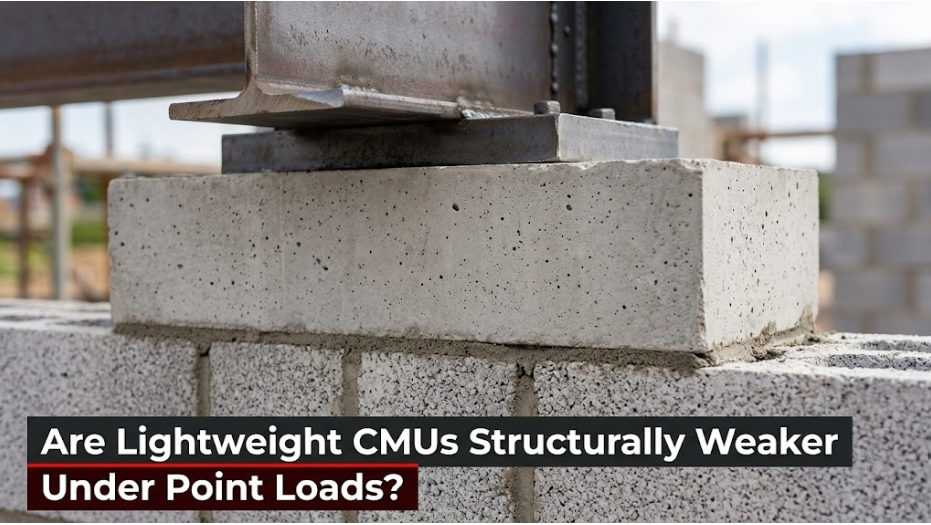
When an unreinforced or hollow block wall receives a high concentrated force, the localized bearing pressure directly under the beam flange can far exceed the masonry’s allowable bearing stress (Fb), leading to localized face-shell spalling or shear punching.
Are Lightweight CMUs Structurally Weaker Under Point Loads?
A widespread misconception in the local market suggests that because a lightweight block is lighter, it must be inherently weaker under concentrated stress.
The governing standard for loadbearing masonry-ASTM C90 (Standard Specification for Loadbearing Concrete Masonry Units)-classifies concrete blocks by oven-dry density:
- Lightweight Units: Density less than 105lb/ft3 (<1,680kg/m3).
- Medium Weight Units: Density between 105and125lb/ft3 (1,680–2,000kg/m3).
- Normal Weight Units: Density greater than 125lb/ft3 (>2,000kg/m3).
Crucially, ASTM C90 enforces the identical minimum net compressive strength of 2,000 psi (13.8 MPa) across all three density classes. A certified lightweight CMU manufactured with high-grade expanded shale or structural volcanic pumice meets the same compressive threshold as a dense stone-aggregate block.
| Technical Parameter | Engineered Lightweight CMUs (PrimeCrete) | Normal-Weight CMUs | Autoclaved Aerated Concrete (AAC / CLC) | Traditional Clay Bricks (Awwal) |
| Dry Density | 1,200–1,600kg/m3 | >2,000kg/m3 | 500–750kg/m3 | 1,700–1,950kg/m3 |
| Net Compressive Strength | 2,000psi (13.8MPa) | 2,000psi (13.8MPa) | 450–750psi (3–5MPa) | 1,200–1,800psi (Variable) |
| Direct Point Load Resistance | High (when grouted & plated) | High (when grouted & plated) | Low (requires cast RC pads) | Moderate (prone to shear cracks) |
| Dead Load Contribution | 30–40% Lower | Baseline (Heavy) | Lowest | High |
Unlike cellular lightweight concrete (CLC) or non-structural AAC blocks-which have fragile compressive thresholds (3–5 MPa) and crush easily under point loads-engineered lightweight CMUs are fully capable of resisting heavy concentrated loads when detailed according to established masonry codes.
4 Engineering Rules to Handle Concentrated Loads on Lightweight CMUs
To safely support heavy point loads on walls built with lightweight CMUs, structural engineers apply four primary detailing techniques:
1. Distribute Pressure Using Steel Bearing Plates
A steel beam should never rest directly on bare concrete block face shells. Under TMS 402/602 (Building Code Requirements and Specification for Masonry Structures), the allowable bearing stress (Fb) on grouted masonry is governed by:
Fb=0.33f’mA2A10.60f’m
Where:
- f’m = Specified compressive strength of the masonry assembly.
- A1 = Direct bearing area of the plate.
- A2 = Effective dispersal area confined within the masonry.
A properly sized structural steel bearing plate broadens the contact area, keeping the localized stress beneath the critical crushing limit of the block.
2. Grout the Block Cores Directly Beneath the Load Node
Hollow blocks rely on thin face-shells and cross-webs. Subjecting an ungrouted hollow block to a point load produces high localized shear and bending stresses across the webs.
To turn hollow units into solid load-bearing pillars, the vertical cores directly under the bearing plate must be fully grouted using fine or coarse grout (ASTM C476) and reinforced with vertical steel rebar. For complete core placement guidelines, see our site manual on which hollow concrete block cores should be grouted.
3. Integrate Continuous Reinforced Bond Beams
A continuous reinforced bond beam constructed with U-blocks or knocked-out hollow units acts as an integrated lintel beam. It receives concentrated reactions from joists or purlins and spreads the stress downward at a 45-degree angle (or 1:1 slope) across several adjacent units, neutralizing the risk of localized shear failure.
4. Maintain Proper Edge Clearances
Placing a concentrated load too close to the end of an unconfined wall or adjacent to an expansion joint reduces the masonry’s lateral confinement. Maintain adequate distance from wall corners and openings, or build an integrated reinforced pilaster to anchor the load safely down to the foundation.
Lightweight CMUs vs. Other Building Units in Pakistan
When specifying load-bearing walls subject to concentrated mechanical equipment, industrial hoists, or structural steel framing:
- Versus Hollow Concrete Blocks: Standard normal-weight hollow units perform similarly under point loads, but lightweight CMUs provide substantially better thermal insulation and place far less seismic mass on the building structure during earthquake tremors in northern and western Pakistan.
- Versus Solid Concrete Blocks: For extreme heavy-duty industrial bearing points (such as unreinforced bearing under massive bridge girders or deep retaining structures), solid blocks eliminate core-grouting steps entirely. Review our analysis on whether concrete bricks crack under heavy loads to compare stress distribution profiles between solid masonry and hollow-core assemblies.
Site Inspection Checklist for Pakistani Contractors
Before landing steel beams or heavy precast girders onto lightweight CMUs:
- [ ] Verify Block Compliance: Ensure the supplier provides batch test certificates verifying ASTM C90 compliance (2,000psi).
- [ ] Inspect Grout Consolidation: Check that all structural cores beneath the bearing plate are filled solid with fluid grout (minimum 8-to-11-inch slump) and mechanically vibrated to eliminate internal voids.
- [ ] Check Bedding Mortar: Use high-strength Type M or Type S cement-sand mortar under the top bearing courses to handle shear stress transitions.
- [ ] Anchor Bolt Positioning: Ensure anchor bolts embedded in the grouted CMU cores have adequate edge distance and development length before tightening baseplate nuts.
When engineered with grouted vertical cores and properly dimensioned bearing plates, lightweight CMUs handle concentrated structural loads with high reliability, giving builders the strength of conventional concrete alongside the superior insulation and reduced dead weight of lightweight masonry.
