
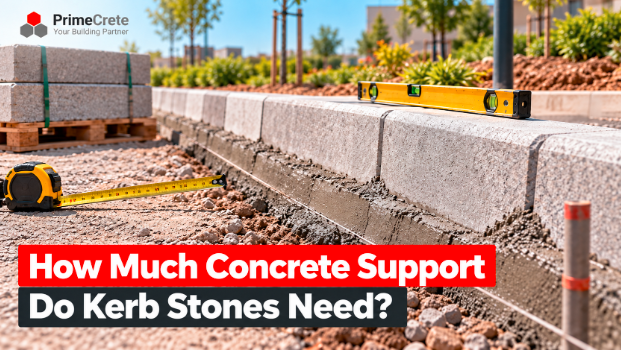
Walk through almost any housing society in Rawalpindi or Peshawar and you will find kerbs that lean outward, sit crooked, or have simply walked away from the road edge. The kerb stones themselves are often fine. What failed was the concrete holding them in place, or the lack of it.
At PrimeCrete, we manufacture concrete kerb stones at Hattar Industrial Estate for roads, parking areas and landscaping projects, and the question we hear from contractors is practical: how much concrete do kerb stones actually need? This article explains the concrete bed and haunch, what controls their size, how support should change with the application, a worked quantity example, and the installation mistakes that make kerbs lean.
The Short Answer
Most road and parking kerbs need two things: a continuous concrete bed underneath and a concrete haunch behind, both sitting on a compacted granular sub-base. Many highway standard details use a bed and sub-base in the region of 150 mm thick, with the haunch rising a substantial part of the kerb’s height. The exact dimensions depend on kerb size, traffic, ground conditions and the project specification.
What the Bed and Haunch Actually Do
A kerb stone is a precast concrete unit that forms the edge of a road, parking area, footpath or landscaped bed. It holds the pavement edge in place, guides vehicles and directs surface water. On its own, a kerb is just a heavy block standing on its edge. The concrete around it turns it into a restraint.
- Sub-base: a compacted granular layer that gives the whole kerb line a firm, even foundation.
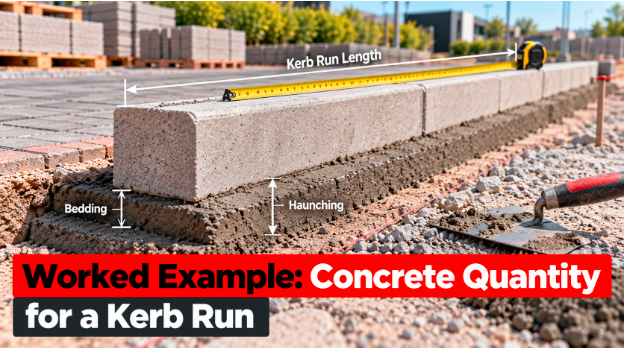
- Concrete bed: a continuous strip of concrete under the kerb that spreads load into the sub-base and sets the kerb’s line and level.
- Haunch (backing): a wedge of concrete placed behind the kerb, bonded to the bed, that resists the kerb tipping over when wheels hit it or paving pushes against it.
UK highway authority standard details show this arrangement clearly. Oxfordshire County Council’s standard details for concrete kerbs and channels place the kerb foundation on a rolled sub-base of at least 150 mm and state that the bed and backing should normally be laid in one operation. The same drawing calls for dowel bars or a reinforced, two-stage bed where kerbs are vulnerable or heavy goods vehicles are likely.
What Controls How Much Concrete a Kerb Needs
The right amount of support depends on several linked factors, not one magic number:
- Kerb size and upstand. A taller exposed face creates more leverage when struck, so it needs a deeper haunch.
- Traffic type. Footpath edging, car parking, bus routes and truck yards impose very different impact and wheel loads.
- Ground conditions. Soft clay, made ground and waterlogged soil need a better sub-base and sometimes a wider bed.
- What sits behind the kerb. A kerb backed by paving or a footpath gets some support; one backed by soft soil or a planter gets very little.
- Concrete quality and timing. Bed and haunch only work as one unit if they bond properly.
The Highland Council’s precast concrete kerb standard details require the haunching concrete to go in within one hour of laying the concrete bed, so the two bond rather than form a weak joint. That timing detail is often ignored on Pakistani sites, where haunching sometimes happens the next day, or never.
Kerb Support by Application
| Application | Typical support approach | Key concern |
| Garden and landscape edging | Concrete bed with light haunch | Alignment, soil movement |
| Footpaths and walkways | Full bed and haunch | Pedestrian edge stability |
| Residential streets and driveways | Full bed and haunch on compacted sub-base | Wheel strikes, paving thrust |
| Commercial parking areas | Full bed and deeper haunch | Frequent impacts, turning tyres |
| Bus routes, truck yards, industrial roads | Engineer-designed bed, haunch, often dowels or reinforcement | Heavy repeated impact |
This table describes general practice. The project drawings or the engineer should set the actual bed thickness, haunch height and concrete grade. For choosing the kerb profile itself for car parks, see our guide on the best kerb stone for parking areas in Pakistan.
How to Install Kerb Stones with Proper Concrete Support
- Excavate to the designed depth. Allow for sub-base, bed and kerb height.
- Compact the formation. Remove soft spots and compact the natural ground.
- Lay and compact the sub-base. Use well-graded crushed stone and compact in layers.
- Place the concrete bed. Set out a continuous strip along the string line.
- Set the kerbs on the fresh bed. Tap them to line and level, with joints as specified.
- Haunch immediately. Place the backing concrete while the bed is still fresh, and compact it against the back of the kerb.
- Cure the concrete. Keep it damp and protected, especially in Pakistani summer heat, before backfilling or loading.
Worked Example: Concrete Quantity for a Kerb Run
The calculation below uses assumed dimensions to show the method. Replace them with your project’s actual drawing dimensions.
Assumptions: kerb run length 100 m; concrete bed 300 mm wide × 150 mm deep; triangular haunch 150 mm wide at its base × 150 mm high; 10% wastage.
\text{Bed per metre} = 0.30 \times 0.15 = 0.045\ \text{m}^3
\text{Haunch per metre} = \tfrac{1}{2} \times 0.15 \times 0.15 \approx 0.011\ \text{m}^3
\text{Total} = (0.045 + 0.011) \times 100 \times 1.10 \approx 6.2\ \text{m}^3
So this example needs roughly 6.2 m³ of concrete per 100 m of kerb. A deeper haunch, wider bed or heavier-duty detail will increase that figure. Kerb runs on curves, at dropped crossings and around drainage inlets also use more concrete than a straight run.
Checklist Before Laying Kerbs
- Confirm kerb type, size and upstand from the drawings
- Confirm bed thickness, haunch height and concrete grade
- Check sub-base thickness and compaction
- Plan dowels or reinforcement where heavy vehicles will strike kerbs
- Arrange concrete supply so haunching follows bedding without delay
- Plan drainage gaps, inlets and dropped crossings in advance
- Allow time for curing before loading or backfilling
Common Mistakes to Avoid
- Laying kerbs on loose soil or a sand bed. The kerb settles unevenly and starts to lean within months.
- Haunching the next day, or not at all. The bed and haunch then act as separate pieces, and the kerb rotates under impact.
- Using a thin smear of mortar instead of a concrete bed. Mortar is for fine levelling, not for structural support.
- Ignoring water. Monsoon runoff that undermines the sub-base will undo the best concrete work.
- Buying weak kerbs to save cost. Good support cannot fix a unit that chips or cracks on first impact. Our guide on how to choose kerb stone that won’t crack or chip covers what to check.
Frequently Asked Questions
Can kerb stones be laid without concrete?
Light garden edging in low-risk areas is sometimes laid on compacted material only. Kerbs along roads, driveways and parking areas need a concrete bed and haunch to resist vehicle impacts and paving thrust.
Why are my kerbs leaning outward?
The usual causes are a missing or undersized haunch, a haunch placed after the bed had set, a soft or wet sub-base, or repeated wheel strikes on a kerb that was never designed for them.
Should the haunch go to the top of the kerb?
Not always. Many standard details stop the haunch below the top so soil, paving or a footpath can finish against the kerb. Where kerbs face heavy impacts, designers may bring the backing higher or add dowels.
Which concrete grade should I use?
Use the grade stated in the project specification. Highway authorities set specific mixes for kerb beds and haunching, and heavier-duty applications generally call for stronger concrete.
Conclusion
Kerb stones need a compacted sub-base, a continuous concrete bed and a properly bonded haunch. The amount of concrete depends on kerb size, traffic, ground conditions and what sits behind the kerb, so the project drawings should define it. Haunch while the bed is fresh, protect the sub-base from water, and the kerb line will stay straight for years.
Planning roads, parking areas or landscaping in your project? Explore PrimeCrete’s concrete kerb stones for roads, parking and landscaping and contact our team about profiles, quantities and delivery.
