
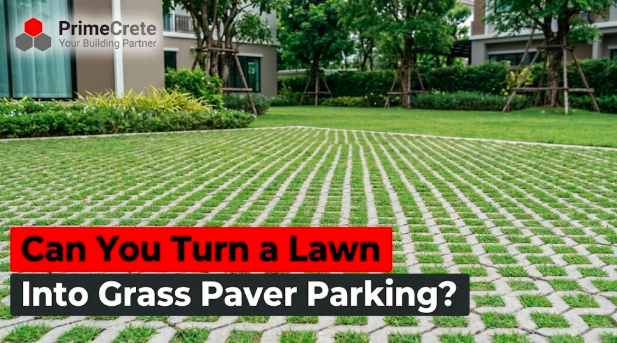
Many Pakistani homeowners face the same dilemma. The family now has two cars, guests arrive on weekends, and the front lawn is the only free space. Paving it over feels like a loss, and a muddy lawn full of tyre ruts after every monsoon spell is no better. Grass pavers promise both: a green lawn that can also carry cars.
At PrimeCrete, we manufacture grass pavers for driveways, parking areas, walkways and green public spaces. This guide explains whether you can convert a lawn into grass paver parking, what the construction actually involves, when grass will survive and when it will not, and what it takes in Pakistani heat and rain.
The Short Answer
Yes, but not by laying grass pavers on top of the existing lawn. You must dig out the turf and topsoil, build a compacted crushed-stone base, add a thin bedding sand layer, lay the grid pavers with edge restraints, then fill the openings with topsoil and grass. Grass suits occasional or overflow parking. Where cars park all day, every day, gravel infill usually performs better.
What Is a Grass Paver?
A grass paver, also called a concrete grid paver, is a precast concrete unit with open cells. The concrete ribs carry vehicle loads, while soil and grass in the cells let rainwater soak in and keep the surface green.
The Concrete Masonry & Hardscapes Association (CMHA) technical note on concrete grid pavements summarises ASTM C1319, the US specification for these units: a minimum nominal thickness of 80 mm, average compressive strength of at least 35 MPa, average water absorption of no more than 160 kg/m³, and solid concrete covering 45% to 75% of the surface. Because the ribs are thin, unit quality matters, so learn how to check grass paver quality before buying.
Why You Cannot Lay Pavers Directly on a Lawn
Lawn soil is soft, organic and full of roots. It compresses under car wheels, holds water in the monsoon and dries and cracks in June. Pavers laid straight onto it will rock, tilt, crack and sink within months. A grass paver surface is a pavement, so it needs the same layered build-up as any other driveway, with grass added on top.
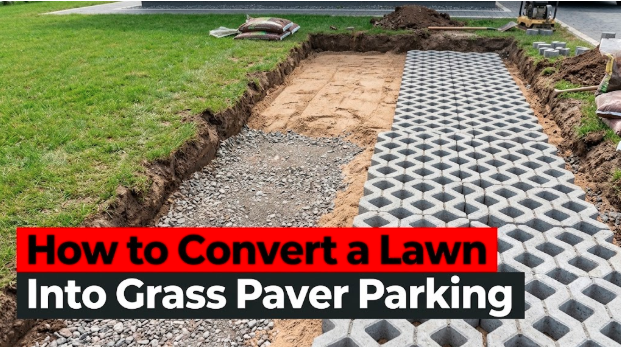
How to Convert a Lawn Into Grass Paver Parking
- Plan the layout. Mark the parking bays, the drive path and any walking route. CMHA suggests solid pavers for pedestrian paths, since grids are uncomfortable to walk on.
- Remove turf and topsoil. Strip all grass, roots and soft organic soil. Keep good topsoil aside for filling the grid cells later.
- Compact the subgrade. CMHA recommends compacting the soil to at least 95% standard Proctor density. Weak clays, high water tables or flood-prone low spots need a thicker or cement-stabilised base, often with geotextile.
- Build the base. Place and compact dense-graded crushed stone. CMHA recommends at least 200 mm of compacted aggregate base for driveways and parking lots.
- Install edge restraints. Fix concrete kerbs or edging on the compacted base so the grids cannot shift under turning tyres.
- Spread bedding sand. Screed washed concrete sand to an even 13 to 25 mm. Do not use stone dust.
- Lay the grids. Leave 3 to 6 mm joints so units do not touch, and cut units to fill the edges.
- Fill and compact. Sweep topsoil into the cells, then vibrate the grids into the sand with a plate compactor fitted with a protective pad.
- Seed or plant. Seed or plug the cells, top up soil and water thoroughly.
- Wait before parking. CMHA notes grass typically needs three to four weeks to establish, and its guide specification suggests keeping traffic off for about 30 days.
Worked Example: How Deep Do You Dig?
Assume 80 mm grid pavers, 25 mm bedding sand and a 200 mm aggregate base. The finished surface sits about 80 + 25 + 200 = 305 mm above the bottom of the excavation. For two parking bays of about 5 m × 5 m (25 m²), excavation is roughly 25 × 0.305 ≈ 7.6 m³ of soil, before allowing for the base extending past the edges. Treat these figures as a planning estimate; weak soil may need a deeper base.
Will Grass Actually Survive?
This is where most lawn conversions succeed or fail. CMHA notes that most grasses need at least five hours of sunlight a day, and that cars parked all day on consecutive days can kill grass through constant shade and engine heat.
| Use pattern | Best infill | Why |
| Guest or weekend parking | Topsoil and grass | Grass gets sun and recovery time |
| Daily parking, cars leave during the day | Grass, with care | Works in sunny spots with watering |
| Car parked all day, every day | Gravel infill | Shade and heat kill grass |
| Heavy vehicles or frequent turning | Engineered permeable paving | Exceeds the grid system’s comfort zone |
Pakistani summers add stress. In Lahore, Multan or Peshawar, grid cells can dry out quickly, so plan for regular watering. Warm-season, wear-tolerant grasses such as Bermuda grass (doob) are common choices, but ask a local nursery or turf specialist which variety suits your sun and water. If you cannot maintain grass, CMHA advises filling the cells with crushed stone instead.
Drainage and the Monsoon
Grass pavers reduce runoff substantially. CMHA gives a runoff coefficient of 0.2 to 0.4 for grids with established grass, close to natural grassed areas, compared with 0.9 to 1.0 for conventional impervious paving. That makes a real difference to waterlogged porches during the monsoon.
They still need a drainage plan. Over poorly draining clay, CMHA recommends a perforated drain pipe in the base. Keep mud and sediment from washing onto the grids, because silt clogs the soil and kills the grass. If a past attempt turned into a mud patch, read about how proper installation stops grass pavers getting muddy.
Common Mistakes to Avoid
- Laying grids on the old lawn without excavation or a base
- No edge restraint, so perimeter units drift and tilt
- Parking too early, before roots establish
- Expecting grass under a car parked 24/7
- Using stone dust as bedding instead of washed concrete sand, which CMHA advises against
Frequently Asked Questions
Can grass pavers handle daily car parking?
The concrete grids can, if the base is built correctly. Grass may struggle where a car stays all day, so consider gravel infill for those bays.
Do grass pavers need maintenance?
Yes. Grassed grids need ordinary lawn care: watering, mowing, weeding and occasional fertilising.
Can trucks or water tankers use grass pavers?
CMHA designs grids for driveways, parking and fire lanes with a 200 mm minimum base, but frequent heavy traffic calls for engineered design or permeable interlocking pavement.
Is the conversion reversible?
Largely, yes. Grids can be lifted and reused, although you would need to replace the base with topsoil to return to a full lawn.
Conclusion
You can turn a lawn into grass paver parking, but treat it as building a driveway that happens to be green. Excavate, compact, build a proper base, restrain the edges and give the grass time and sunlight. Match the infill to how the space is really used: grass for occasional parking, gravel for cars that never leave. PrimeCrete can help homeowners, architects and developers plan grass paver parking and quantities for projects across Pakistan.
