
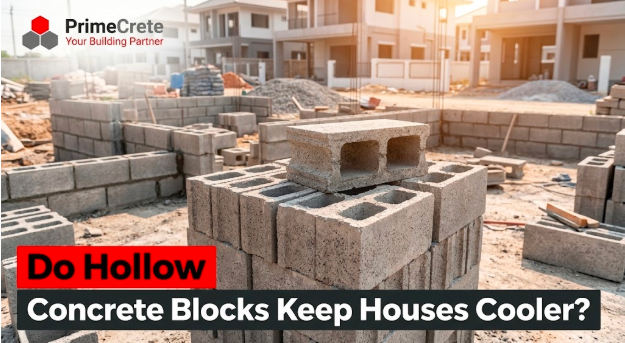
Homeowners and developers planning residential construction in Lahore, Multan, Islamabad, or Peshawar frequently encounter a persistent claim: building with hollow concrete blocks naturally keeps a house cooler during scorching Pakistani summers. With grid electricity tariffs climbing and summer daytime temperatures routinely topping 43°C to 47°C, the appeal of a walling material that reduces indoor heat gain and air conditioning bills is undeniable.
However, thermal performance in masonry is rarely a simple matter of marketing promises. While air cavities inside hollow blocks do interrupt direct conductive heat transfer, indoor thermal comfort depends on the interplay between thermal resistance, thermal mass, night-purge ventilation, and building envelope design. Sourcing precision-molded hollow concrete blocks from modern automated manufacturers like PrimeCrete gives builders a superior baseline for thermal efficiency, but unlocking those cooling benefits requires understanding how heat actually moves through a concrete masonry wall.
The Short Answer
Yes, hollow concrete blocks keep houses cooler than solid concrete blocks and provide comparable or superior daytime heat resistance to standard red clay bricks when properly detailed. Their internal air voids create a thermal barrier that reduces direct conductive heat flux, while their physical concrete mass provides a thermal lag of 6 to 8 hours, delaying peak daytime heat from penetrating living spaces until cooler evening hours. However, hollow blocks cannot keep a house cool alone if the RCC roof slab is uninsulated or if solar radiation enters through unshaded windows.
The Thermodynamics of Hollow Block Masonry
To evaluate whether hollow concrete blocks actually cool a house, we must examine the three fundamental heat transfer mechanisms at work across a masonry wall: conduction, convection, and radiation.
1. Thermal Conductivity and Air Cavity Resistance
Dense concrete has a relatively high thermal conductivity ($k \approx 1.30 \text{ to } 1.70 \text{ W/m}\cdot\text{K}$), meaning it conducts heat relatively quickly. By contrast, completely still air has an exceptionally low thermal conductivity ($k \approx 0.026 \text{ W/m}\cdot\text{K}$).
By introducing engineered internal cavities that constitute 40% to 50% void area (under ASTM C90 standards), hollow concrete blocks replace dense, heat-conducting concrete with air pockets. While convective air looping and internal radiative heat transfer across the void faces mean an empty core does not insulate as perfectly as stagnant air, the net thermal conductance across the unit drops significantly compared to solid masonry.
2. Thermal Resistance (R-Value) and Thermal Transmittance (U-Factor)
According to data compiled in NCMA TEK 6-2C: R-Values and U-Factors of Single-Wythe Concrete Masonry Walls, an uninsulated 8-inch (200 mm) normal-weight hollow concrete block wall provides a steady-state thermal resistance (R-value) of approximately $1.72 \text{ to } 2.10 \text{ h}\cdot\text{ft}^2\cdot^\circ\text{F/Btu}$ ($R_{SI} \approx 0.30 \text{ to } 0.37 \text{ m}^2\cdot\text{K/W}$), with an overall heat transmission coefficient (U-factor) of around $0.48 \text{ to } 0.58 \text{ Btu/h}\cdot\text{ft}^2\cdot^\circ\text{F}$.
An 8-inch solid concrete wall, by comparison, provides an R-value of only 1.10to1.35, transferring conductive heat inward roughly 30% to 40% faster.
3. Thermal Mass and the “Time Lag” Effect
In hot, arid climates across Pakistan, steady-state R-values tell only half the story. The dominant thermodynamic benefit of masonry is thermal mass and its associated time lag (thermal phase shift) and decrement factor.
As documented in civil engineering research published in the ASCE Journal of Materials in Civil Engineering, dense exterior masonry acts as a thermal sponge. When the exterior wall surface heats up to 60°C under midday sun, the masonry absorbs this thermal energy rather than transmitting it instantly. The concrete slowly warms, delaying the release of heat into the building interior by 6 to 8 hours.
In cities like Islamabad, Rawalpindi, and Lahore, where daytime temperatures of 42°C drop to 27°C at night, this thermal lag pushes the heat wave into the late evening hours, when windows can be opened for natural night-purge ventilation or when lower off-peak ambient air allows air conditioners to run at significantly higher thermodynamic efficiency.
Thermal Performance Comparison: Hollow Blocks vs. Alternatives
The table below contrasts standard wall assemblies commonly built across Pakistan:
| Masonry Assembly | Wall Thickness | Typical R-Value (RSI / US R) | Thermal Lag (Time Phase Shift) | Cavity Insulation Potential | Structural & Weight Benefit |
| 8″ Hollow Concrete Block | 8 in (200 mm) | $0.32 \text{ m}^2\cdot\text{K/W}$ / R-1.8 | 6 to 8 Hours | High (cores can accept loose-fill perlite or EPS inserts) | 35% lighter than solid units; reduces dead load on frames. |
| 8″ Solid Concrete Block | 8 in (200 mm) | $0.21 \text{ m}^2\cdot\text{K/W}$ / R-1.2 | 7 to 9 Hours | None (monolithic solid body) | Maximum dead load; rapid conductive heat transfer. |
| 9″ Traditional Red Clay Brick (Double-Wythe) | 9 in (228 mm) | $0.35 \text{ m}^2\cdot\text{K/W}$ / R-2.0 | 6 to 7 Hours | None (solid masonry bedding) | Heavy; irregular mortar joints create continuous thermal bridges. |
| 8″ Hollow Block with Insulated Cores | 8 in (200 mm) | $0.85 \text{ to } 1.20 \text{ m}^2\cdot\text{K/W}$ / R-4.8 to R-6.8 | 8 to 10 Hours | Maximum (factory EPS or field perlite fill) | Superior energy savings; drastically lowers HVAC tonnage. |
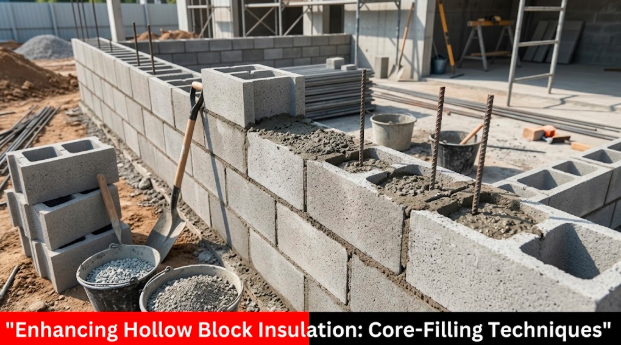
Enhancing Hollow Block Insulation: Core-Filling Techniques
While empty hollow cores resist heat better than solid concrete, natural convection currents inside the open air cells still transport heat across the cavity. Forward-thinking builders in Pakistan can dramatically improve wall thermal resistance using core-insulation techniques:
- Expanded Polystyrene (EPS) Inserts: Custom molded rigid foam plugs inserted into the block cores during manufacturing or wall assembly prevent convective air currents, boosting wall thermal resistance by up to 100% to 150%.
- Hydrophobic Loose-Fill Perlite or Vermiculite: Pouring expanded volcanic perlite directly into the hollow cells as courses are laid eliminates interior air voids and radiant transfer, elevating an 8-inch wall to nearly R-5 to R-6.
- Selective Structural Grouting: In framed or confined masonry buildings, engineers only require specific vertical cores to be grouted with concrete and steel rebar for shear resistance. Leaving non-structural cores ungrouted preserves their insulating air buffers. Grouting every core solid turns the wall into a solid concrete barrier, discarding its thermal insulation benefits.
To ensure your hollow block assembly also resists monsoon rainwater ingress, review our guide on why water enters hollow concrete block walls and proper exterior plaster protection.
The Whole-House Thermal Reality in Pakistan
It is an engineering misconception that merely specifying hollow concrete blocks will transform a house into a self-cooling oasis. External masonry walls account for roughly 20% to 30% of total residential solar heat gain.
If you build hollow block walls but ignore the rest of the building envelope, the house will remain uncomfortably hot:
- The RCC Roof Slab Factor: In single-family 5-marla, 10-marla, and 1-kanal residences across Pakistan, 60% to 70% of summer thermal load enters through the unshaded horizontal roof slab. An uninsulated 6-inch reinforced concrete roof exposed to 12 hours of direct summer sun radiates continuous heat downward, overwhelming any thermal advantage provided by the perimeter walls. Applying roof insulation (such as extruded polystyrene boards under screed, or mud-phooka with light-reflective tiles) is essential.
- Solar Window Gain: Unshaded single-pane windows facing south or west admit direct radiant heat that traps warmth inside the building through the greenhouse effect.
- Mortar Joint Bridging: Using face-shell mortar bedding rather than full-width bed joints keeps the center of the block cavity hollow, preventing mortar from creating a conductive bridge across the inner and outer block faces.
For guidance on movement joint detailing to protect hollow block walls from thermal expansion cracking, see our article on control joints in hollow block walls.
Common Mistakes That Ruin Hollow Block Cooling Performance
- Grouting All Cores Solid Unnecessarily: Site contractors often fill every single core with wet aggregate concrete under the false belief that “more concrete equals a better house.” This eliminates air pockets, turning the wall into a dense, rapid heat conductor.
- Skipping External Plaster or Reflective Finishes: Raw, dark exterior block surfaces absorb high levels of solar radiation. Applying a light-colored, reflective cement-sand render or elastomeric coating dramatically lowers exterior surface temperatures.
- Leaving Top Cores Open to Hot Attic Air: If wall parapets or top courses are left uncapped, hot air circulates through the interior cores, heating the inner face shells from within.
- Neglecting Night-Purge Ventilation: A masonry house with high thermal mass stores heat. If closed tight during cool summer nights, the trapped heat slowly radiates into bedrooms. Ventilating the building after sunset purges the stored structural heat.
Multi-Stakeholder Checklist for Energy-Efficient Masonry
For Architects & Energy Consultants
- Specify hollow concrete blocks complying with ASTM C90 void ratio standards.
- Detail face-shell mortar bedding on non-retaining architectural masonry to eliminate continuous thermal bridging.
- Pair hollow block wall specifications with roof insulation systems (R15) and external window shading.
For Contractors & Site Supervisors
- Grout only those vertical cores designated on structural drawings for reinforcement.
- Ensure mortar does not fall into un-grouted cores, maintaining clean internal air buffers.
- Apply a well-cured 15–20 mm external cement plaster to block wind-driven heat and air infiltration.
For Homeowners & Private Builders
- Understand that hollow blocks moderate temperature swings through thermal lag, but do not replace the need for ceiling insulation.
- Ask your supplier for machine-made blocks produced with uniform shell thickness and consistent void geometry.
- Utilize natural cross-ventilation during late evening and early morning hours to exhaust stored thermal mass energy.
Frequently Asked Questions
Are hollow concrete blocks cooler than traditional red clay bricks?
Hollow concrete blocks offer a slightly higher basic thermal resistance (R-value) than a single wythe of brick, while a standard 9-inch double-wythe brick wall offers similar thermal resistance. However, hollow blocks provide distinct advantages: their internal cores can be filled with insulation (perlite or EPS) to more than double their heat resistance, and their uniform dimensions allow precise, thinner mortar joints that minimize thermal bridging.
Can I fill hollow concrete block cores with thermopore (EPS) balls?
Yes. Filling non-structural hollow block cavities with loose EPS beads, vermiculite, or expanded perlite significantly reduces internal convective looping and radiation heat transfer. This upgrade can elevate an 8-inch wall from approximately R-1.8 to over R-5, noticeably reducing air conditioning power consumption in extreme climates like Multan or Jacobabad.
Why does my room still feel hot even though the walls are built with hollow blocks?
Walls are only one component of the building envelope. In most Pakistani houses, the primary source of extreme indoor heat is the flat RCC roof slab, which absorbs intense direct solar radiation all day. If the roof slab lacks thermal insulation, or if large windows lack shading, heat will pour into the room regardless of the wall material.
Does grouting every core in a hollow block wall make the house warmer?
Yes. Completely grouting all cores with dense gravel-concrete mortar fills the insulating air voids with conductive solid material. While structurally necessary in designated shear panels or retaining structures, fully grouting ordinary walls degrades their thermal resistance back toward that of a solid concrete block wall.
Build Resilient, Energy-Conscious Homes with PrimeCrete
Hollow concrete blocks offer Pakistani builders an effective, engineered solution for moderating extreme summer temperatures. By combining internal air cavity resistance with natural thermal lag, precision hollow CMUs help buffer indoor living spaces from peak daytime heat waves. When integrated into a holistically designed building envelope featuring insulated roof slabs, reflective external plaster, and properly planned ventilation, hollow block masonry delivers tangible reductions in lifetime cooling costs.
PrimeCrete manufactures high-performance hollow concrete masonry units using automated German MASA machinery at Hattar Industrial Estate. Our precision molding technology guarantees uniform face-shell thickness, balanced void geometries, and verified compressive strength meeting ASTM C90 and BS 6073 benchmarks.
Connect with our engineering and technical sales team to request product data sheets, explore core-insulation options, or arrange bulk supply for your residential or commercial development.

[…] For homeowners interested in general indoor comfort rather than grout-specific performance, our separate article explains whether hollow concrete blocks keep houses cooler. […]