
When structural engineers and commercial contractors across Pakistan design multi-storey framed buildings or residential masonry in seismic zones like Islamabad, Rawalpindi, and Peshawar, weight reduction is a primary design objective. Specifying lightweight concrete masonry units made with natural volcanic aggregates like pumice significantly reduces building dead load, foundation costs, and earthquake inertia forces. However, when project specifications call for higher vertical bearing or lateral wind and seismic resistance, a critical engineering question arises: does pouring grout into the hollow cells of lightweight CMUs actually increase wall strength?
The short answer is a definitive yes, but the mechanics extend far beyond simply pouring wet mix into open voids. While grouting transforms hollow panels into composite structural systems capable of carrying substantial axial, flexural, and shear loads, unconsidered grouting can inadvertently compromise thermal insulation. Specifying engineered lightweight concrete masonry units (CMUs) from automated manufacturers like PrimeCrete ensures precision-engineered void geometry and consistent aggregate matrix density, establishing the required baseline for high-performance grouted masonry assemblies.
The Short Answer
Yes, grouting lightweight CMUs significantly increases structural wall strength. Filling the hollow cells with engineered masonry grout increases total axial load-carrying capacity by 70% to 100% simply by converting hollow cross-sectional net area into solid gross bearing area. More importantly, grouting encapsulates vertical and horizontal steel reinforcement, transforming brittle unreinforced masonry into a ductile reinforced system that increases out-of-plane flexural strength by 300% to 500% and dramatically improves in-plane seismic shear resistance.
The Structural Mechanics of Grouted Lightweight CMUs
To understand why grouting enhances structural capacity, engineers distinguish between unit compressive strength, net-area masonry compressive strength (f‘m), and total wall load capacity (Pn).
1. Axial Compressive Capacity (Pn)
In an ungrouted hollow CMU wall, vertical loads are resisted solely by the net cross-sectional area of the face shells and cross webs. Under building code design standards such as the ASTM C90 Standard Specification for Loadbearing Concrete Masonry Units, units must meet strict dimensional and strength criteria based on net cross-sectional area.
When cells are filled with fluid masonry grout conforming to the ASTM C476 Standard Specification for Grout for Masonry, the effective bearing area shifts from net area ($A_n \approx 50\% \text{ to } 55\%$) to full gross area ($A_g = 100\%$). Even if the specified compressive strength of the composite masonry (f’m) remains constant, doubling the loaded cross-sectional area effectively doubles the ultimate gravitational load the wall can support.
2. The Pumice Aggregate Suction Advantage
A unique thermodynamic and chemical advantage occurs when grouting lightweight CMUs made with natural pumice aggregates.
Pumice-based lightweight concrete has an open micro-cellular structure with higher capillary suction than dense river-gravel concrete. When high-slump grout (slump of 8 to 11 inches / 200 to 280 mm) is poured into the cores:
- The porous pumice cell walls rapidly draw excess water out of the grout paste during placement.
- This dewatering process immediately reduces the effective water-cement (w/c) ratio of the core grout from roughly 0.70 down to an optimal 0.40–0.45.
- The lower in-situ w/c ratio dramatically boosts the actual compressive strength of the hardened grout core well above standard laboratory cylinder breaks.
- The cement paste migrates slightly into the open pores of the pumice block face, creating an unbreakable mechanical interlock along the grout-block interface that resists vertical slip under shear loads.
For a deeper analysis of how pumice aggregates enhance thermal and physical performance, see our technical article on how lightweight CMUs reduce heat in Pakistani buildings.
Flexural and Shear Resistance: The Real Power of Grouting
In earthquake-prone regions across Pakistan-including Islamabad, Rawalpindi, Peshawar, Quetta, and the northern territories falling in Seismic Zones 2B, 3, and 4-unreinforced masonry is vulnerable to brittle failure. Grouting lightweight CMUs unlocks critical lateral resistance mechanisms:
Out-of-Plane Flexural Bending Strength
Unreinforced masonry walls subjected to lateral wind gusts or seismic ground shaking resist bending purely through the tensile bond strength between the mortar and the block face shell (typically a meager 0.20 to 0.35 MPa). Once this microscopic bond snaps, the wall collapses outward.
Grouting allows high-yield deformed steel reinforcing bars (typically Grade 60 rebar, diameter 12 mm to 16 mm) to be centered securely in the cores. The hardened grout transfers tensile stresses directly into the embedded steel. This transforms the assembly into a ductile reinforced concrete masonry beam-column, increasing out-of-plane flexural bending capacity by 300% to over 500%.
In-Plane Shear Resistance (Racking Strength)
During an earthquake, lateral inertial forces generate heavy diagonal shear stresses across masonry shear walls. Ungrouted hollow blocks fail along diagonal stair-step shear cracks. Grout cores, combined with horizontal joint reinforcement or bond beams, act as continuous structural dowels that tie the masonry together, converting individual block units into monolithic shear panels.
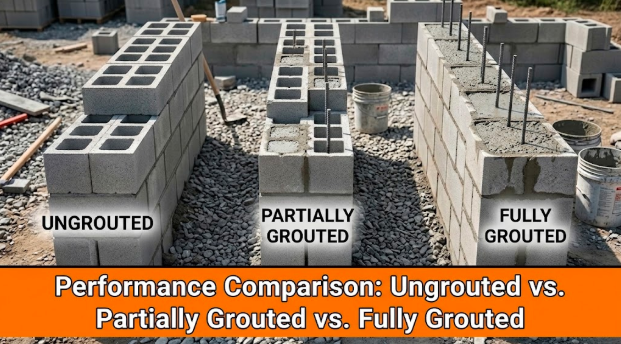
Performance Comparison: Ungrouted vs. Partially Grouted vs. Fully Grouted
Engineers must choose between ungrouted, partially grouted, and fully grouted wall assemblies depending on load demands:
| Performance Metric | Ungrouted Hollow Lightweight CMU | Partially Grouted Lightweight CMU (Cores @ 32″ / 48″) | Fully Grouted Lightweight CMU (100% Cores Filled) |
| Effective Bearing Area | Net Face-Shell Area (~50%–55%) | Net Area + Grouted Core Columns (~65%–75%) | 100% Gross Cross-Sectional Area |
| Axial Load Capacity | Baseline (1.0) | Moderate Increase (1.3to1.5) | Maximum Increase (1.8to2.1) |
| Out-of-Plane Flexural Strength | Very Low (tensile bond dependent) | High (steel spans between reinforced cores) | Maximum (continuous reinforced panel) |
| Thermal Resistance (R-Value) | Highest (~R-2.2 to R-2.5 via pumice cores) | Balanced (~R-1.8 to R-2.1) | Lowest (~R-1.3 to R-1.5; grout thermal bridges) |
| Wall Dead Weight (8″ CMU) | Lightest (~105–125 kg/m²) | Moderate (~160–190 kg/m²) | Heaviest (~240–280 kg/m²) |
| Seismic Zone Suitability | Non-load-bearing / Low seismic (Zone 1) | Ideal for Residential & Low-Rise (Zone 2B/3) | High Shear Panels / Basements (Zone 3/4) |
The Structural vs. Thermal Dilemma in Pakistan
While fully grouting every core maximizes strength, it introduces a severe building physics compromise: thermal bridging.
Natural pumice lightweight CMUs provide exceptional thermal insulation due to trapped micropores in the volcanic aggregate. However, structural grout is a dense mixture of cement, sand, and fine pea gravel with high thermal conductivity ($k \approx 1.30 \text{ to } 1.50 \text{ W/m}\cdot\text{K}$).
When every vertical core is filled solid, the wall’s overall thermal resistance (R-value) drops by up to 35% to 45%. In air-conditioned commercial and residential buildings, this converts perimeter walls into continuous heat conductors during peak 45°C summer heatwaves.
The Engineering Solution: Partial Grouting
For most structural designs across Pakistan, partial grouting offers the optimal compromise:
- Vertical cores are grouted only where reinforcement is required by design calculations-typically at 32 inches (800 mm), 48 inches (1,200 mm), or adjacent to wall corners and window/door jambs.
- The remaining unreinforced cores remain hollow, preserving their lightweight thermal barrier.
- Cores can even be filled with hydrophobic expanded perlite or EPS inserts to maximize thermal resistance while maintaining structural shear walls.
To prevent drying shrinkage and crack formation along continuous grouted panels, review our technical guide on control joints in hollow and lightweight block walls.
Grout Mix Specifications: Concrete vs. Masonry Grout
A catastrophic mistake frequently observed on Pakistani construction sites is filling block cores with standard structural concrete (1:2:4 mix with low slump) using 3/4-inch crushed gravel.
Standard concrete will not work inside masonry cores. Coarse gravel arches across the webs, creating massive internal air voids, “honeycombing,” and unbonded reinforcement.
ASTM C476 Grout Requirements
- Slump: Must be mixed to a fluid consistency of 8 to 11 inches (200 to 280 mm) as measured by ASTM C143 slump cone test. Fluidity is essential to surround rebar and fill small spaces without mechanical pressure.
- Compressive Strength: Specified 28-day compressive strength (f’g) must equal or exceed the specified compressive strength of the masonry (f’m), and never be less than 2,000 psi (13.79 MPa) under ASTM C1019 testing procedures.
- Aggregate Size: Use Fine Grout (graded sand only) for narrow grout spaces (< 2 inches), or Coarse Grout (maximum 3/8-inch / 9.5 mm pea gravel) for standard 8-inch CMU cores.
Common Mistakes When Grouting Lightweight CMUs
- Grouting Without Cleanout Openings on High Pours: Pouring grout over wall heights exceeding 5 feet without cleanout openings at the base. Mortar droppings accumulate at the bottom course, preventing the grout from bonding to the foundation dowels.
- Using Vibrators Incorrectly: Over-vibrating with heavy concrete vibrator pokers can blow out the face shells of lightweight CMUs. Instead, use a pencil vibrator (diameter < 1 inch) for brief consolidation, followed by a reconsolidation pass 5 to 10 minutes later after water has been absorbed.
- Placing Loose Rebar Without Centralizers: Letting rebar lean against the inner face shell. If the steel touches the block wall, it loses grout cover, leaving it exposed to corrosion and preventing proper developmental bond. Rebar must be centered using plastic or wire positioners.
- Failing to Grout Bond Beams Continuously: Interrupting the horizontal bond beam grout at partition walls, which breaks the structural diaphragm chord.
Multi-Stakeholder Checklist for Grouted CMU Construction
For Structural Consultants & Specifiers
- Clearly denote on drawings which cores are to be grouted (partial vs. full grouting).
- Specify grout in accordance with ASTM C476 by proportions or minimum 28-day strength (f’g2,000psi or f’m).
- Detail vertical reinforcement splices and specify rebar positioners every 200 bar diameters.
For Contractors & Site Supervisors
- Verify 8 to 11-inch slump at the point of pour; never place stiff grout.
- Clean mortar fins and droppings from core spaces before pouring grout.
- Consolidate grout thoroughly using small-diameter mechanical vibration or rodding.
- Reconsolidate grout within 10 to 20 minutes to eliminate shrinkage settlement voids.
For Procurement & Project Owners
- Source factory-made lightweight CMUs with verified dimensional tolerances and aggregate composition.
- Confirm testing documentation for both masonry units (ASTM C90) and site grout specimens (ASTM C1019).
- Ensure site teams do not order standard structural concrete mix for masonry core grouting.
Frequently Asked Questions
Does grouting a lightweight CMU wall make it as strong as a solid concrete wall?
A fully grouted lightweight CMU wall behaves very similarly to a solid concrete wall of equal thickness in terms of gross axial bearing capacity and shear resistance. While cast-in-place concrete may achieve higher raw material compressive strength (3,000 to 4,000 psi), a fully grouted CMU wall provides ample structural capacity for multi-storey load-bearing buildings while eliminating complex shuttering and formwork costs.
Can I use regular 1:2:4 site concrete to fill hollow block cores?
No. Standard site concrete contains coarse aggregates (up to 20 mm / 3/4 inch) and a low slump (2 to 4 inches), causing it to bridge and create huge voids around reinforcement inside the narrow cores. Masonry grout must conform to ASTM C476 with fine aggregate or pea gravel (under 3/8 inch) and an 8 to 11-inch slump to ensure complete, void-free encapsulation.
Will grouting every core make my building hotter in summer?
Yes. Solid grout cores act as thermal bridges. While lightweight pumice CMUs offer excellent thermal insulation when hollow, filling all cores with dense cement grout increases the thermal conductivity of the wall, lowering its overall R-value. For energy-conscious projects, engineers recommend partial grouting (grouting only structural cores at designated intervals) to maintain thermal buffers in the remaining hollow cells.
What is the minimum compressive strength required for masonry grout?
Under ASTM C476 standards, masonry grout must achieve a minimum 28-day compressive strength (f’g) of 2,000 psi (13.79 MPa). Furthermore, the specified grout strength must equal or exceed the specified compressive strength of the masonry assembly (f’m).
Engineered Strength Meets Lightweight Efficiency
Grouting lightweight CMUs provides a powerful structural solution for modern construction in Pakistan. By combining the dead-load reduction and thermal advantages of pumice aggregates with the high compressive and flexural capacity of reinforced grout cores, engineers can design tall, earthquake-resistant structures without excessive foundation mass. Adopting partial grouting strategies delivers the ideal balance between structural safety and long-term energy performance.
PrimeCrete produces precision-molded lightweight concrete masonry units utilizing automated German MASA technology at Hattar Industrial Estate. Manufactured with carefully graded natural pumice aggregates, our lightweight CMUs meet stringent ASTM C90 and BS 6073 standards for compressive strength, fire resistance, and dimensional uniformity.
Contact PrimeCrete’s technical engineering team today to review structural specifications, discuss custom CMU densities, or request product submittals for your upcoming project.
