
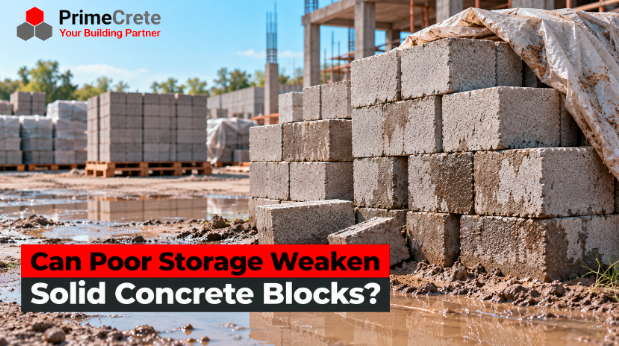
Poor storage can damage solid concrete blocks before they ever become part of a building. On construction sites across Pakistan, blocks often remain outdoors for days or weeks, exposed to monsoon rainfall, soil contamination, heavy equipment, and careless handling. Even factory-produced solid concrete blocks can suffer cracks, chipped corners, and moisture-related installation problems when contractors neglect proper storage.
For engineers, builders, and procurement teams, understanding concrete block storage is essential for protecting material quality and preventing avoidable masonry failures. PrimeCrete, a concrete-products brand of Pak Dream (Pvt) Ltd, manufactures concrete masonry products at Hattar Industrial Estate, Haripur, using automated production technology. However, good manufacturing quality must be supported by proper transportation, handling, and site storage.
This guide explains how storage conditions affect concrete block strength, which risks matter most, and how Pakistani contractors can protect blocks before installation.
Can Poor Storage Actually Reduce Concrete Block Strength?
Yes, poor storage can weaken or damage solid concrete blocks, particularly when blocks are immature, physically overloaded, or exposed to damaging environmental conditions. However, rain or ordinary outdoor exposure does not automatically reduce the compressive strength of properly cured concrete.
The distinction matters because engineers must separate actual material deterioration from surface moisture, staining, or cosmetic damage.
Three mechanisms deserve attention:
- Physical damage: Falling, impact, unstable stacking, and mechanical loading can cause cracks.
- Early-age curing problems: Improper moisture and temperature control during initial curing can compromise strength development.
- Contamination and moisture movement: Mud, standing water, and uncontrolled moisture can interfere with masonry construction and create serviceability problems.
A mature, properly cured concrete block may tolerate normal outdoor exposure without significant strength loss. Nevertheless, damaged blocks should never be accepted for structural masonry solely because they appear dense or heavy.
What Happens When Solid Concrete Blocks Are Stored Incorrectly?
1. Cracking From Unstable Stacking
Improper block stacking can create concentrated loads and mechanical damage.
If workers stack blocks on uneven ground, the bottom units may receive loads through small contact areas rather than uniform bearing surfaces.
Potential problems include cracked edges, localized crushing, and unstable piles that create workplace hazards.
Stacking height should follow the manufacturer’s guidance, pallet design, ground-bearing capacity, and site safety requirements. No universal safe stacking height applies to every block size and storage arrangement.
2. Moisture Exposure During Monsoon Rainfall
Rainfall requires careful interpretation.
Fully cured concrete does not automatically become weaker simply because it gets wet. However, prolonged contact with wet soil, repeated uncontrolled saturation, and poor drainage can create several problems:
- Mud and contamination on bonding surfaces
- Delays before applying specified finishes
- Moisture-related staining
- Increased handling weight while wet
- Difficulties controlling masonry moisture conditions
On sites around Islamabad, Rawalpindi, Lahore, and Peshawar, storage planning should account for seasonal rain and surface runoff.
3. Damage From Premature Handling
Concrete products gain strength as cement hydration progresses under suitable curing conditions.
If blocks leave the curing process before achieving the required handling strength, transport and stacking can produce damage that might not occur in mature units.
Manufacturing age alone does not prove compliance. Acceptance should depend on the required product specification, curing records where relevant, and verified test performance.
4. Impact From Site Machinery
Forklifts, loaders, delivery trucks, and wheelbarrows can damage concrete blocks when construction teams use the storage area as an unrestricted traffic route.
Repeated pallet movement may also loosen stacks.
Designating protected storage zones reduces unnecessary handling and material wastage.
How Should Solid Concrete Blocks Be Stored on Construction Sites?
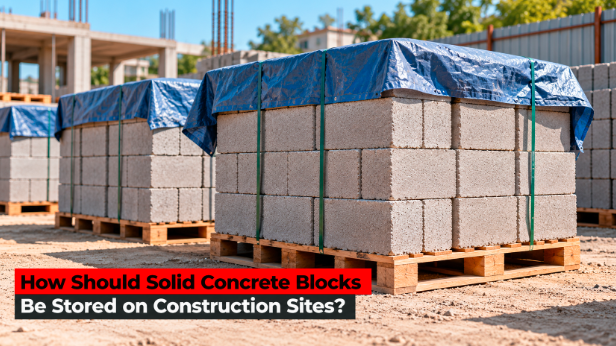
Store concrete blocks on a firm, level, well-drained surface, with suitable support beneath the stacks and protection against impact, contamination, and excessive moisture exposure.
Choose a Raised, Stable Storage Area
Avoid placing blocks directly on mud or soft excavated soil.
Use sound pallets, properly designed supports, or a stable hardstanding area capable of carrying the anticipated loads.
Keep the storage location away from excavation edges, drainage channels, and regular vehicle routes.
Protect Blocks Without Trapping Moisture
Use a suitable weather cover when needed, particularly during heavy rainfall.
Maintain practical ventilation and avoid wrapping wet blocks in an airtight covering for extended periods.
For blocks still undergoing specified curing, follow the manufacturer’s curing procedure rather than applying ordinary storage instructions.
Separate Blocks by Specification
Organize solid concrete masonry units according to:
- Nominal dimensions
- Actual product type
- Specified compressive strength
- Manufacturing batch
- Intended structural or nonstructural application
This approach helps contractors avoid mixing products with different performance requirements.
Minimize Double Handling
Plan delivery and unloading so blocks can move directly from their assigned storage area to the relevant work zone.
Use mechanical handling equipment appropriate for pallet weight and stability.
Do not throw or drop blocks during unloading.
Which Standards Help Verify Concrete Block Quality?
ASTM C90 and ASTM C140/C140M provide recognized specification and testing frameworks for applicable concrete masonry units. They help engineers evaluate product quality independently of marketing claims.
ASTM C90: Loadbearing Concrete Masonry Units
ASTM C90 -Standard Specification for Dry-Cast Loadbearing Concrete Masonry Units addresses solid and hollow concrete masonry units manufactured using applicable dry-cast processes.
The specification covers important physical characteristics, including unit classification and performance requirements.
Under ASTM C90-24a, the specified average net-area compressive strength for compliant units is at least 2,000 psi (approximately 13.8 MPa), subject to the standard’s sampling and individual-unit criteria.
That figure must not be treated as a universal guaranteed strength for every concrete block sold in Pakistan.
ASTM C140/C140M: Testing Concrete Masonry Units
ASTM C140/C140M -Sampling and Testing Concrete Masonry Units describes methods for evaluating applicable characteristics such as:
- Compressive strength
- Dimensions
- Water absorption
- Density
- Moisture content
The applicable edition and relevant product specification determine which measurements and acceptance limits should be used.
For important projects, contractors should request representative laboratory reports and verify that the sampled units correspond to the supplied batch.
How Can Contractors Identify Damaged Concrete Blocks?
Visual inspection is the first screening step, but laboratory testing is necessary when the structural acceptability of questionable blocks cannot be established from documented evidence.
Before masonry work begins, inspect blocks for visible cracks, damaged bearing surfaces, severe edge breakage, and unusual dimensional variations.
Minor surface imperfections do not automatically make a block structurally defective. Conversely, apparently clean surfaces do not prove adequate compressive strength.
When a batch looks suspicious, segregate it until the responsible engineer determines whether additional testing or replacement is necessary.
Practical Site Inspection Checklist
| Inspection Item | What to Check |
| Storage foundation | Stable, level, and adequately drained |
| Pallet condition | No broken supports or dangerous leaning |
| Visible cracks | Cracks through webs, faces, or bearing areas |
| Water exposure | Standing water, mud, or contamination |
| Block identification | Correct size, batch, and specified grade |
| Handling damage | Broken corners and impact fractures |
| Documentation | Relevant test reports and delivery records |
A simple delivery inspection form can help establish whether defects existed before or after material acceptance.
Can Damaged Concrete Blocks Still Be Used?
Some blocks with minor cosmetic defects may remain usable, but blocks with significant cracks or damaged load-bearing surfaces should not enter structural masonry without engineering approval.
The decision depends on the block’s purpose and the applicable project specification.
For example, a minor corner chip may be acceptable in a noncritical location if the engineer permits it. A through-crack in a loadbearing wall unit presents a substantially different concern.
Do not use damaged units in foundations, structural walls, or high-stress locations simply to avoid replacement costs.
How Much Money Can Poor Block Storage Waste?
Poor construction material storage affects more than individual block prices.
Consider a hypothetical Pakistani housing project that orders 5,000 solid blocks at PKR 100 each.
If poor handling renders 4% unusable:
- Total blocks purchased: 5,000
- Damaged blocks: 200
- Unit cost: PKR 100
- Direct material loss: PKR 20,000
This is an illustrative calculation, not a measured PrimeCrete loss rate or current quotation.
The actual financial impact may be higher when projects include replacement freight, extra unloading, labour delays, and disposal.
For broader purchasing considerations, read PrimeCrete’s guide to solid concrete block sizes, grades, and delivery costs in Pakistan.
Construction teams managing different masonry units may also benefit from the company’s storage, handling, and curing guidance for hollow concrete blocks.
Why Is Proper Storage Especially Important in Pakistan?
Pakistan presents several practical challenges for material storage.
During summer, high surface temperatures can accelerate moisture loss from concrete products that have not completed their specified curing process.
During monsoon periods, inadequate drainage can leave pallets surrounded by water and mud.
On congested residential plots, especially 5-marla and 10-marla developments, limited storage space may encourage excessive stacking or frequent relocation.
Industrial construction sites face additional risks from heavy vehicle movements and large material deliveries.
The best approach is to prepare a material-storage plan before the first delivery arrives.
Frequently Asked Questions
Does rain weaken solid concrete blocks?
Not necessarily. Properly cured concrete blocks can tolerate normal rainfall, but immature blocks, poor drainage, physical damage, and contamination can create problems.
Can concrete blocks be stored directly on the ground?
It is better to use stable, well-drained support or suitable pallets. Direct ground contact increases the risk of contamination, uneven support, and moisture-related difficulties.
How long can solid concrete blocks remain in storage?
There is no universal maximum storage period for all properly cured blocks. Storage suitability depends on product condition, handling history, environment, and project requirements.
How do you know whether a block has sufficient strength?
Review applicable batch documentation and obtain testing under the specified standard, such as ASTM C140/C140M, when necessary.
Should cracked solid concrete blocks be used in loadbearing walls?
Not without approval from the responsible engineer. Significant cracks may reduce reliability and should trigger rejection or technical evaluation.
Conclusion
Poor storage can compromise solid concrete block quality, even when the products initially meet the required manufacturing specification.
The greatest risks come from physical damage, unstable stacking, premature handling, contamination, and inadequate control of early-age curing conditions.
Contractors should use stable storage surfaces, protect units against unnecessary impact, inspect deliveries, and verify performance against the relevant specification.
For Pakistan construction projects, PrimeCrete offers a starting point for discussing solid block requirements, batch documentation, delivery arrangements, and suitable material selection.
