
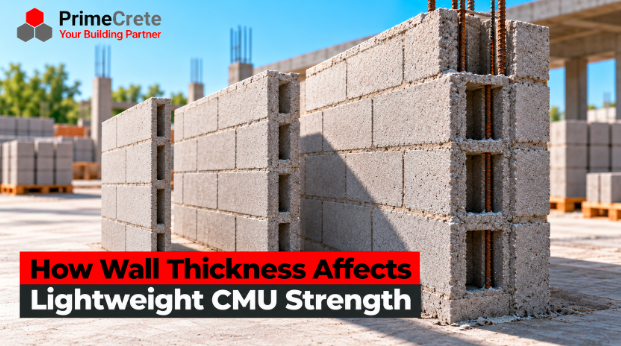
Choosing the correct lightweight CMU wall thickness is a structural and architectural decision, not simply a matter of choosing the thickest available block. In Pakistani housing, commercial developments, and industrial projects, engineers must balance wall stability, dead load, thermal performance, available floor area, and material cost. Lightweight concrete masonry units (CMUs) provide an alternative to conventional dense masonry, but their strength depends on both material properties and wall design.
PrimeCrete, the concrete-products brand of Pak Dream (Pvt) Ltd, offers pumice-based lightweight masonry units for projects seeking reduced wall weight and improved thermal characteristics. However, wall thickness, compressive strength, and loadbearing capacity must be evaluated separately.
This guide explains how lightweight CMU dimensions influence structural performance, wall stability, thermal resistance, and project costs in Pakistan.
Does Increasing Wall Thickness Make Lightweight CMU Walls Stronger?
Increasing the thickness of a lightweight CMU wall can improve certain aspects of structural performance, particularly out-of-plane stability and resistance to bending. However, thicker walls are not automatically stronger in every respect, and wall thickness does not change the intrinsic compressive strength of the block material.
For example, consider walls with nominal thicknesses of 100 mm, 150 mm, and 200 mm.
If their unit strength, construction quality, height, and support conditions are otherwise comparable, the thicker wall generally offers greater section capacity for some loading conditions.
But the actual results depend on:
- Block geometry and net cross-sectional area
- Unit and masonry compressive strength
- Wall height and unsupported length
- Reinforcement and grouting
- Mortar quality
- Eccentric loading
- Lateral restraint
- Openings and movement joints
An engineer must evaluate all these variables before determining a wall’s safe capacity.
What Are Lightweight Concrete Masonry Units?
Lightweight concrete masonry units are manufactured concrete blocks with lower density than normal-weight CMUs.
Manufacturers can reduce density by using lightweight aggregates, such as pumice, rather than relying exclusively on conventional dense mineral aggregates.
The resulting material may offer lower structural dead load and different thermal characteristics.
Under ASTM C90’s weight classification system, lightweight units have an oven-dry density below approximately 1,680 kg/m³ (105 lb/ft³).
Not every block marketed as lightweight automatically complies with ASTM C90.
How Does Pumice Affect CMU Performance?
Pumice contains natural internal pores that reduce aggregate density.
These pores can also reduce thermal conductivity, depending on mixture design, moisture content, and manufacturing conditions.
PrimeCrete’s published product information gives indicative pumice lightweight CMU thermal conductivity of 0.20-0.53 W/m·K, compared with 1.60-3.60 W/m·K for normal-weight CMUs.
These are published product-page ranges, not independently verified batch test results or complete wall assembly values.
Designers should request relevant test methods, supporting reports, and project-specific thermal calculations before using such figures for compliance modelling.
What Lightweight CMU Thicknesses Are Commonly Considered?
Nominal wall thicknesses of approximately 100 mm, 150 mm, and 200 mm are useful planning categories, but actual product availability and structural suitability must be confirmed.
| Nominal Thickness | Approximate Imperial Equivalent | Potential Application |
| 100 mm | 4 inches | Engineered internal partitions |
| 150 mm | 6 inches | Selected infill or partition walls |
| 200 mm | 8 inches | Walls requiring greater thickness or stability |
These are illustrative nominal thickness categories, not verified PrimeCrete stock sizes or blanket approvals for particular structural uses.
A 100 mm unit is approximately 3.94 inches thick, whereas a nominal 4-inch masonry unit may have a smaller specified actual manufactured width.
Always distinguish between nominal and actual dimensions.
How Does Wall Thickness Affect Compressive Load Capacity?
Wall thickness influences the available compression area, but masonry compressive strength depends on the complete wall system rather than thickness alone.
For a simplified illustration:
Suppose two hypothetical wall sections have the same length and an assumed uniform effective compressive stress.
One section is 100 mm thick and another is 200 mm thick.
Their gross cross-sectional areas per metre of wall length are:
- 100 mm wall: 100,000 mm²
- 200 mm wall: 200,000 mm²
The thicker section has twice the gross cross-sectional area.
However, this does not establish twice the permitted axial load.
Hollow-cell geometry, mortar, slenderness, material properties, eccentricity, reinforcement, and code-based strength-reduction factors all influence actual design capacity.
What Is the Difference Between Gross-Area and Net-Area Strength?
Gross area refers to the overall cross-sectional area based on external dimensions.
Net area excludes voids according to the applicable measurement method.
For hollow blocks, these can differ substantially.
ASTM C90 expresses the specified compressive strength of applicable units using net-area criteria.
Therefore, engineers should not compare a reported net-area block strength directly with a gross-area wall calculation without appropriate conversion and design assumptions.
Why Is Wall Slenderness Important?
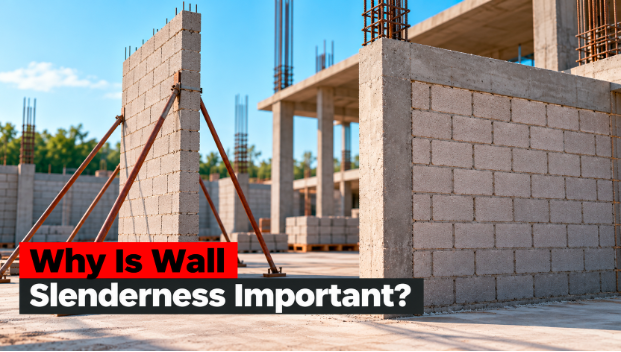
Wall slenderness describes the relationship between unsupported wall dimensions and thickness, making it an important consideration for stability and lateral loading.
For a simplified height-to-thickness comparison:
A 3,000 mm high wall with a 100 mm thickness has a geometric ratio of 30.
The same height with a 200 mm thickness produces a ratio of 15.
| Wall Height | Wall Thickness | Simple Height/Thickness Ratio |
| 3,000 mm | 100 mm | 30 |
| 3,000 mm | 150 mm | 20 |
| 3,000 mm | 200 mm | 15 |
These ratios are illustrations only. Actual effective slenderness and code acceptance depend on support conditions, effective dimensions, loads, and masonry design provisions.
Thinner walls may require more careful attention to lateral support, movement joints, reinforcement, and wall connections.
This is particularly important for high partitions, exposed boundary walls, and large wall panels.
What Standards Apply to Lightweight CMU Strength?
ASTM C90 addresses applicable loadbearing CMU product requirements, while ASTM C140/C140M provides the corresponding testing framework.
ASTM C90: Masonry Unit Classification
ASTM C90 -Dry-Cast Loadbearing Concrete Masonry Units covers applicable solid and hollow CMUs made with normal-weight or lightweight aggregates.
ASTM C90-24a specifies a minimum average net-area compressive strength of 2,000 psi (approximately 13.8 MPa), alongside other requirements.
The applicable unit designation, acceptance criteria, and project specification must be confirmed before selection.
ASTM C140/C140M: Verification Testing
ASTM C140/C140M describes applicable methods for determining unit dimensions, compressive strength, density, and water absorption.
Engineers should review laboratory test documentation rather than assuming all lightweight masonry products have equivalent strength.
For nonloadbearing units, ASTM C129 may be relevant when the project specification adopts it.
Building-level structural design must follow the applicable Pakistani code requirements and engineer-approved masonry design methodology.
How Does CMU Thickness Affect Thermal Performance?
Increasing wall thickness generally increases resistance to conductive heat transfer when material conductivity remains unchanged.
The basic material-layer thermal resistance is:
R = t / k
Where:
- R = thermal resistance (m²·K/W)
- t = material thickness (m)
- k = thermal conductivity (W/m·K)
Consider a hypothetical homogeneous layer with conductivity of 0.35 W/m·K.
| Thickness | Calculated Material-Layer Resistance |
| 100 mm | 0.286 m²·K/W |
| 150 mm | 0.429 m²·K/W |
| 200 mm | 0.571 m²·K/W |
These calculations illustrate the thickness relationship.
They are not certified PrimeCrete wall R-values because actual masonry assemblies may contain hollow cells, mortar joints, plaster, reinforcement, moisture, and other thermal paths.
In Islamabad, Rawalpindi, and Lahore, wall selection should account for solar exposure, building orientation, insulation, ventilation, and cooling requirements.
For more context, read PrimeCrete’s analysis of how lightweight masonry can reduce heat transfer in Pakistani buildings.
Does a Thicker Lightweight CMU Wall Increase Building Dead Load?
Yes, greater wall thickness generally increases the amount of masonry material per square metre, assuming similar density and geometry.
Consider an illustrative calculation using a homogeneous material density of 1,200 kg/m³.
For one square metre of wall:
- 100 mm thickness: 120 kg
- 150 mm thickness: 180 kg
- 200 mm thickness: 240 kg
The calculation follows:
Mass per m² = thickness × density
These figures exclude mortar, reinforcement, finishes, and openings. They also do not represent the actual mass of hollow CMU walls.
For hollow units, calculate weight using manufacturer-reported unit mass and the number of blocks required.
Reducing unnecessary wall dead load can be valuable in multistorey construction, but structural benefits must be evaluated within the complete building design.
How Should Engineers Select Lightweight CMU Thickness?
Select CMU thickness based on approved structural calculations, the wall’s function, exposure conditions, and verified product properties—not simply unit price.
For residential or commercial projects, engineers should establish whether the wall is a partition, exterior infill, loadbearing assembly, or freestanding boundary.
They should then verify:
- Applicable structural loads
- Wall height and support conditions
- Required fire resistance
- Thermal and acoustic requirements
- Unit compressive strength
- Density and dimensions
- Reinforcement and grouting details
- Openings and service penetrations
Thicker masonry may improve stability but consumes more floor area.
For smaller Pakistani houses, this can create meaningful architectural trade-offs.
PrimeCrete’s residential concrete block wall planning guide provides additional considerations for housing applications.
Frequently Asked Questions
Is a 200 mm lightweight CMU wall stronger than a 100 mm wall?
It can have greater capacity under some comparable loading and support conditions, but engineering calculations must establish the actual difference.
Can lightweight CMUs be loadbearing?
Yes, if the selected units comply with the applicable loadbearing specification and the masonry assembly has a suitable engineered design.
Does increasing wall thickness improve insulation?
Generally, yes, when material conductivity remains comparable. Actual wall performance depends on the complete assembly.
Does lightweight concrete mean weak concrete?
No. Lightweight classification concerns density, not an automatic failure to meet strength requirements.
What is the best CMU wall thickness for a 10-marla house?
There is no universal answer. The engineer must consider structural function, geometry, height, loading, and the architectural design.
Conclusion
Lightweight CMU wall thickness affects structural stability, compression area, thermal resistance, dead load, and usable building space.
Although thicker walls can improve certain forms of structural performance, block thickness alone cannot establish safe loadbearing capacity.
Contractors and engineers in Pakistan should select lightweight masonry using verified product properties, applicable standards, and a complete wall design.
PrimeCrete’s pumice-based CMU range offers a potential solution for projects that require an appropriate balance of masonry weight, structural performance, and thermal characteristics.
