
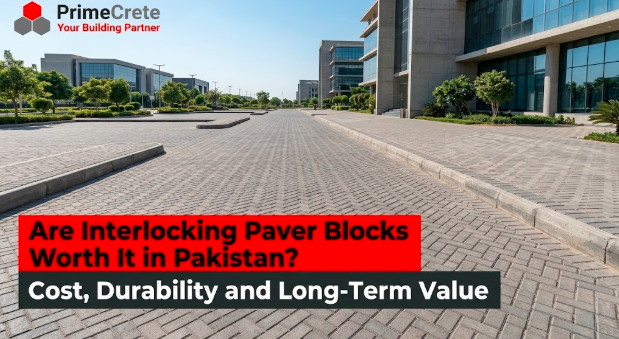
A homeowner paving a car porch or a contractor developing a commercial parking area often faces the same decision: install plain concrete, asphalt, or interlocking paver blocks? The initial material price matters, but maintenance, drainage, appearance, and future repairs can change the long-term economics. For buyers comparing options, PrimeCrete’s interlocking concrete paving products provide a starting point for evaluating sizes, applications, and project specifications.
PrimeCrete, the concrete-products brand of Pak Dream (Pvt) Ltd, manufactures paving and masonry products at Hattar Industrial Estate using MASA Germany machinery. This guide explains whether interlocking paver blocks are worth installing in Pakistan, with practical advice on material performance, installation costs, vehicle loading, monsoon drainage, and purchasing decisions.
Are Interlocking Paver Blocks Worth the Investment?
Yes, interlocking paver blocks can provide good long-term value for driveways, parking areas, footpaths, and commercial landscapes when the project uses suitable units and a properly designed pavement foundation.
Their main advantage is that individual units form a modular pavement surface.
Unlike a continuous concrete slab, a block-paved surface can often be opened for underground repairs and reinstated without replacing a large surrounding area.
However, pavers are not automatically cheaper, stronger, or more durable than every alternative.
Their performance depends heavily on subgrade preparation, base construction, drainage, installation quality, and expected traffic.
What Are Interlocking Paver Blocks?
Interlocking concrete pavers are manufactured concrete units installed in a repeated pattern over a prepared foundation and bedding layer.
They create a segmental pavement in which adjacent units work together through joint interaction and lateral restraint.
A typical installation includes:
- Prepared and compacted natural soil, called the subgrade
- Engineered granular sub-base or base
- Suitable bedding sand
- Concrete paving units
- Filled joints
- Edge restraints such as concrete kerbs
These components form a pavement system.
The pavers are the visible surface, but the layers underneath provide essential structural support.
What Are the Main Benefits of Interlocking Pavers in Pakistan?
The most valuable benefits of interlocking paver blocks in Pakistan are repairability, design flexibility, potential durability, and suitability for different traffic applications.
1. Individual Pavers Can Be Replaced
If a service pipe beneath the driveway requires repair, contractors can lift the affected paving units and excavate the necessary area.
After reinstating and compacting the underlying materials, they can relay usable pavers.
This makes modular paving attractive in housing schemes, commercial areas, and sites with underground utilities.
Repairability does not mean maintenance-free performance. Poorly reinstated foundations can settle again.
2. Different Patterns and Colours Are Available
Concrete pavers can support different architectural layouts, subject to the manufacturer’s available shapes and finishes.
Designers can use borders, contrasting paving zones, and repeated geometric patterns to define parking bays or pedestrian routes.
Colour and appearance are useful, but surface aesthetics should never override structural requirements.
3. They Can Suit Vehicle Traffic
Correctly designed interlocking concrete pavement can accommodate cars and, in more demanding applications, heavier vehicles.
The appropriate system depends on cumulative traffic loading, axle weights, ground conditions, and unit properties.
Do not assume every decorative paver is suitable for a loaded truck.
4. Maintenance Can Be Localized
When an isolated area settles, contractors may be able to lift the units, correct the underlying foundation, and reinstall them.
This flexibility can reduce the need to demolish otherwise serviceable pavement.
The benefit becomes especially useful when the site contains underground cables, drainage lines, or irrigation systems.
How Much Do Interlocking Paver Blocks Cost in Pakistan?
The cost of interlocking paver blocks depends on thickness, shape, colour, specified performance, quantity, transportation, and installation requirements.
There is no single nationwide rate that accurately covers every product and project.
Prices may be quoted per square foot, per square metre, or per piece.
For published pricing context, see PrimeCrete’s 2026 paver block cost guide.
What Should Be Included in the Total Installation Cost?
The total installed price should include more than the paving units.
| Cost element | Why it matters |
| Concrete pavers | Depends on thickness, design and specification |
| Excavation | Creates room for the pavement structure |
| Sub-base materials | Provides load-spreading support |
| Compaction | Helps control future settlement |
| Bedding sand | Supports uniform paver placement |
| Joint filling | Supports interlock |
| Edge restraints | Prevents lateral displacement |
| Drainage | Controls rainwater movement |
| Labour and cutting | Depends on layout complexity |
| Transportation | Depends on project location and quantity |
A low material quote can become expensive when major installation components are excluded.
Example: Comparing Two Paving Quotations
Assume a hypothetical 1,000 sq ft driveway.
Contractor A quotes PKR 150 per sq ft for paving materials only.
Contractor B quotes PKR 250 per sq ft for a defined installed scope.
The estimated totals are:
- Contractor A: PKR 150,000 for materials only
- Contractor B: PKR 250,000 for the stated installation scope
The difference does not establish which proposal offers better value.
You must first confirm the paver specification, excavation, base thickness, compaction, drainage, and other included work.
These numbers are illustrative, not current PrimeCrete quotations.
How Long Do Interlocking Pavers Last?
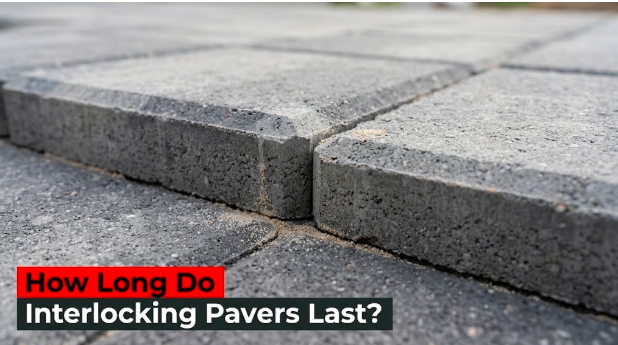
The service life of interlocking paver blocks depends on product quality, pavement design, traffic exposure, drainage, installation, and maintenance.
Well-designed systems can provide long service, but there is no responsible universal lifespan guarantee for every driveway or industrial yard.
A product’s concrete strength is only one performance factor.
Poor support beneath the pavers can produce settlement and cracking even when the units themselves have high compressive strength.
Which Quality Standard Applies?
ASTM C936/C936M covers solid concrete interlocking paving units.
The widely referenced ASTM C936 strength benchmark is an average compressive strength of 55 MPa (8,000 psi), with no individual unit below 50 MPa (7,200 psi) under the applicable testing provisions.
Check the specified edition, including the current ASTM C936/C936M paving unit standard, before setting acceptance criteria.
Do not assume a manufacturer complies with ASTM solely because its pavers look dense or accurately shaped.
Ask for the actual product specifications and relevant test results.
Are 60 mm or 80 mm Interlocking Pavers Better?
Neither thickness is universally better. Paver thickness must match the expected loading and pavement design.
The Concrete Masonry & Hardscapes Association provides general construction guidance for different traffic applications.
| Paver thickness | Common planning context |
| 60 mm | Pedestrian areas, patios, driveways and limited light-vehicle traffic |
| 80 mm | Streets and industrial pavements, subject to engineering design |
| 100 mm | Selected demanding applications where specifically designed |
These are general selection guidelines, not guaranteed vehicle-load capacities.
The CMHA guide to interlocking concrete pavement construction describes foundation, bedding, edge-restraint, and installation requirements.
For a residential car porch, an engineer may select a different pavement structure from one used for a commercial loading yard.
Never select thickness solely from price.
Can Interlocking Pavers Handle Pakistan’s Monsoon Rainfall?
Yes, conventional interlocking paver surfaces can perform in monsoon conditions when the pavement has suitable slopes, drainage outlets, and water-resistant construction details.
However, ordinary interlocking pavers are not automatically permeable pavement systems.
A conventional sand-jointed paver surface may allow some water through joints, but it should not be treated as a designed infiltration system without appropriate testing and specification.
What Causes Water-Related Paver Failures?
Water can weaken unsuitable subgrade soils, wash out poorly contained bedding material, and contribute to settlement.
Common warning signs include:
- Persistent standing water
- Washed-out joint sand
- Localized pavement depressions
- Movement near drain openings
- Pavers that rock under foot or vehicle movement
The solution is often beneath the visible paving surface.
A thicker concrete block cannot compensate for inadequate drainage or an unstable subgrade.
Are Interlocking Pavers Better Than Plain Concrete?
Interlocking pavers vs plain concrete is primarily a decision about site use, maintenance requirements, design flexibility, and lifecycle cost.
| Feature | Interlocking pavers | Cast-in-place concrete |
| Surface construction | Individual modular units | Continuous slab panels |
| Utility access | Units can often be lifted and relaid | May require cutting and replacement |
| Decorative patterns | Wide range of layouts | Finishes and scoring options |
| Joint maintenance | May require periodic joint maintenance | Requires appropriate crack and joint maintenance |
| Vehicle loading | Depends on engineered pavement structure | Depends on slab and foundation design |
| Drainage | Must be specifically designed | Must be specifically designed |
| Localized settlement repair | Often repairable by lifting units | Repair may involve slab replacement or stabilization |
The better option is the one that meets the project’s engineering, maintenance, and budget requirements.
What About Asphalt?
Asphalt can suit roads and large paved areas, depending on traffic, temperature, and maintenance conditions.
Concrete pavers may provide advantages in places where future access to underground services or decorative appearance is important.
Large, continuously trafficked routes need a lifecycle comparison rather than a purely visual preference.
What Installation Mistakes Make Paver Blocks a Poor Investment?
The biggest problems typically begin before the pavers are laid.
Common mistakes include inadequate sub-base compaction, inconsistent bedding thickness, weak edge restraints, and incorrect paving patterns.
For repeated vehicle turning and braking, herringbone arrangements commonly provide better resistance to lateral movement than simple straight-joint patterns.
PrimeCrete discusses these choices in its guide to car-parking paver laying patterns.
A properly compacted foundation, consistent joint filling, and correctly installed kerb restraints are more valuable than choosing an expensive surface colour.
Contractors should also avoid using bedding sand to compensate for an uneven base.
The foundation must be corrected before final paving.
How Do You Calculate the Number of Pavers Required?
Calculate interlocking paver quantities from the net surface area and the installed module of the selected product.
For illustration, assume the installed paver module measures 200 × 100 mm.
Area per unit:
0.2 × 0.1 = 0.02 m²
Units per square metre:
1 ÷ 0.02 = 50 pavers
For a 100 m² surface:
100 × 50 = 5,000 pavers
With 5% cutting and breakage allowance:
5,000 × 1.05 = 5,250 pavers
This is an illustrative calculation using nominal module dimensions. Actual product dimensions, joint spacing, paving pattern, and edge cuts can change the order quantity.
Frequently Asked Questions
Are Interlocking Pavers Good for a House Driveway?
Yes, when selected for the expected vehicle traffic and installed over a correctly designed foundation.
Can Paver Blocks Crack Under Cars?
Yes. Cracking can result from inadequate support, unsuitable units, repeated loading, or poor construction.
Are Interlocking Pavers Slippery in Rain?
Slip resistance depends on the surface texture, finish, contamination, and exposure. Review the specified product’s slip-performance requirements rather than assuming all finishes behave alike.
Are Interlocking Pavers Maintenance-Free?
No. Joint sand, drainage, edge restraints, and occasional settlement repairs may require attention.
Final Thoughts
Interlocking paver blocks are worth considering in Pakistan when buyers value a repairable, modular, visually flexible pavement that can be designed for the intended traffic.
Their long-term value depends more on the complete pavement design than on the appearance of individual blocks.
For a reliable comparison, obtain quotations that identify material specifications, foundation construction, drainage, and installation responsibilities. PrimeCrete can assist with product selection and project-specific paving material requirements.
