
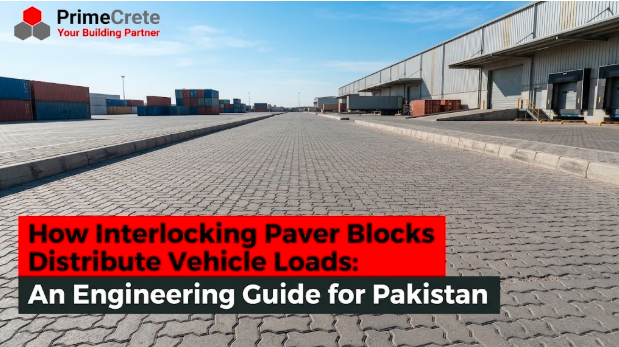
A driveway can look perfectly level when construction finishes, yet develop wheel ruts and displaced paving blocks after months of vehicle movement. The problem often lies in how interlocking paver blocks distribute vehicle loads through their joints, bedding, and supporting layers. This also matters when selecting alternative vehicle-supporting surfaces such as PrimeCrete’s concrete grass pavers, which use a different grid geometry to support traffic while accommodating vegetation or granular infill.
PrimeCrete, the concrete-products brand of Pak Dream (Pvt) Ltd, manufactures paving products at Hattar Industrial Estate using automated MASA Germany technology. For civil engineers, contractors, housing developers, and project managers in Pakistan, understanding paver load distribution helps prevent settlement, cracking, joint movement, and premature pavement failure.
How Do Interlocking Paver Blocks Distribute Vehicle Loads?
Interlocking concrete pavers distribute vehicle loads through interactions between adjacent blocks, joint sand, bedding material, compacted base layers, and the underlying subgrade.
When a vehicle wheel applies pressure to the pavement, the load does not remain confined to the single paver directly beneath the tyre.
Part of the applied load transfers to neighboring units through joint interaction, while the foundation layers spread the load over a wider supporting area.
This process helps reduce concentrated stresses in the underlying soil.
However, the extent of load distribution depends on pavement stiffness, joint condition, block geometry, traffic loading, and foundation design.
What Happens When a Vehicle Wheel Presses on a Paver?
A vehicle wheel applies a localized force to the paving surface.
The resulting pavement response depends on the wheel load, tyre contact area, tyre stiffness, and the mechanical properties of the layers beneath it.
The basic relationship for average contact pressure is:
Pressure = Applied force ÷ Contact area
For example, consider a hypothetical vehicle with a mass of 1,800 kg.
Its approximate static weight is:
1,800 × 9.81 = 17,658 N
If that load were distributed equally between four wheels:
17,658 ÷ 4 = 4,414.5 N per wheel
This is approximately 4.41 kN per wheel.
If one wheel’s assumed contact area is 0.02 m²:
4,414.5 ÷ 0.02 = 220,725 Pa
The average pressure would be approximately 221 kPa.
This calculation is simplified.
Actual vehicles rarely distribute weight equally between all four wheels. Axle configuration, braking, loading conditions, and movement influence the forces transmitted into the pavement.
The calculation describes nominal average contact pressure, not the final stress within the subgrade.
What Are the Three Types of Interlock in Concrete Paving?
A properly designed interlocking concrete pavement develops three forms of interlock: vertical, rotational, and horizontal.
These mechanisms help individual paving units behave as a connected surface.
1. Vertical Interlock
Vertical interlock allows neighboring paving units to participate in resisting loads applied to the surface.
Joint sand facilitates shear transfer between adjacent blocks.
When one unit receives a wheel load, surrounding units can help carry part of the resulting action.
If the joints lose material or become excessively wide, the effectiveness of this interaction may decrease.
2. Rotational Interlock
Rotational interlock limits the tendency of individual pavers to rotate or tilt under loading.
Unit thickness, geometry, joint spacing, adjacent blocks, and edge restraints influence this behavior.
A thin paver over an uneven bedding layer may experience unwanted rotation or rocking.
A suitable unit thickness and properly prepared foundation help maintain stability.
3. Horizontal Interlock
Horizontal interlock resists sideways movement caused by turning, braking, and accelerating vehicles.
Vehicle tyres can generate substantial horizontal forces at entrances, parking areas, slopes, and turning bays.
Laying patterns and edge restraints strongly influence resistance to these forces.
The Concrete Masonry & Hardscapes Association’s structural pavement design guidance explains these three forms of interlock and their importance to pavement performance.
How Do Paver Thickness and Shape Affect Vehicle Loading?
Paver thickness and geometry influence resistance to deformation, rotation, and local damage.
However, thickness alone does not determine the maximum traffic load a pavement can safely carry.
The pavement must be designed for the expected vehicle types, axle loads, traffic repetitions, and subgrade conditions.
Common planning considerations include:
| Paver thickness | Application context |
| 60 mm | Pedestrian zones and selected light-traffic applications |
| 80 mm | Many vehicular applications, subject to engineered design |
| 100 mm | Selected demanding applications requiring project-specific design |
These are indicative categories, not fixed load ratings.
Why Is a Thicker Paver Not Always Better?
A thick paver installed over soft or poorly compacted soil can still settle or crack.
The foundation must provide sufficient support to resist traffic loading throughout the pavement’s design life.
Contractors should prioritize the complete pavement structure rather than relying on one product characteristic.
Why Is the Sub-Base Important for Vehicle Load Distribution?
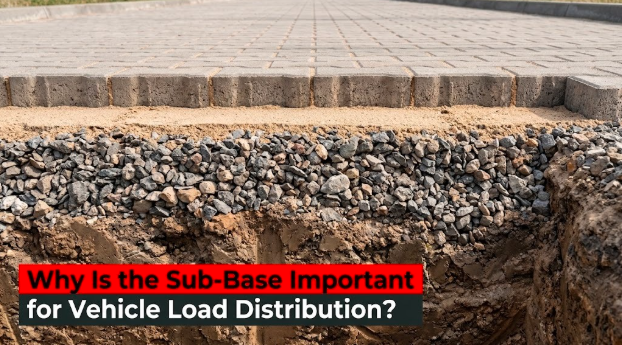
The sub-base and base layers are essential because they support the paving surface and help distribute traffic loads to the natural soil.
A typical segmental concrete pavement contains several functional layers.
Compacted Subgrade
The subgrade is the natural soil or prepared material beneath the constructed pavement.
Its engineering properties help determine the required pavement thickness.
Weak or moisture-sensitive soils may require additional treatment, drainage, or a thicker engineered base.
Granular Base or Sub-Base
Compacted granular layers provide structural support and improve load distribution.
Their thickness depends on the expected loads, ground conditions, and design method.
For demanding projects, engineers may use laboratory and field investigations, including California Bearing Ratio (CBR) testing or other suitable measures of subgrade support.
Bedding Layer
The bedding layer provides a uniform surface for installing pavers.
For conventional sand-set concrete paving, a commonly used guidance value is approximately 25 mm of uncompacted bedding sand, subject to the selected system and installation specification.
Bedding sand must not be used to conceal major irregularities in the compacted base.
Joint Filling
Suitable joint sand supports interaction between neighboring paving units.
Loss of joint material can reduce pavement stability and allow movement under traffic.
What Happens When the Base Is Poorly Compacted?
Inadequate sub-base compaction can cause settlement, rutting, and uneven pavement surfaces.
Consider a driveway constructed over loose, poorly compacted fill.
Each vehicle movement can contribute to further densification or deformation beneath the pavers.
Eventually, the surface may develop localized depressions.
Water accumulation can worsen the problem where soil loses support when wet.
Common Symptoms of Poor Compaction
- Depressions along repeated tyre paths
- Rocking or uneven paving units
- Localized cracking
- Persistent puddles
- Open joints near heavily trafficked areas
- Settlement around service trenches
Replacing only the visible damaged pavers may not solve the underlying problem.
Contractors should inspect the subgrade and base before deciding on repairs.
How Do Grass Pavers Distribute Vehicle Loads?
Concrete grass pavers, also called concrete grid paving units, distribute wheel loads through interconnected concrete ribs and their supporting pavement layers.
Unlike conventional solid interlocking pavers, grass pavers contain openings for vegetation or granular filling.
Their concrete grid provides defined load-bearing contact paths.
When properly specified and installed, they can support suitable vehicle traffic while accommodating landscaping.
However, their load response differs from that of solid interlocking pavers.
Are Grass Pavers Suitable for Car Parking?
Yes, properly designed concrete grass paver systems can suit selected parking areas, residential driveways, and low-frequency vehicle applications.
Actual suitability depends on the paver strength, grid geometry, thickness, supporting base, soil conditions, and expected loading.
Parking a vehicle repeatedly in the same position may also limit grass growth because vegetation needs sunlight and appropriate growing conditions.
For installation details, see PrimeCrete’s guide on preparing and installing grass-paver driveways.
Which Standard Applies to Concrete Grass Pavers?
The relevant product specification for concrete grid paving units is ASTM C1319, covering grid units intended for applications such as vehicular trafficways, parking areas, and soil stabilization.
The ASTM C1319 concrete grid paving unit specification provides the appropriate reference for this product category.
Conventional solid interlocking concrete pavers and open-cell concrete grid pavers are different products.
Their respective standards and test requirements should not be treated as interchangeable.
How Do Braking and Turning Forces Affect Interlocking Pavers?
Braking and steering introduce horizontal forces in addition to vertical wheel loads.
These forces may cause paver rotation, movement, and widening of joints if the pavement lacks adequate restraint.
Areas particularly exposed to repeated horizontal loading include:
- Parking entrances
- Petrol station forecourts
- Ramps
- Sharp vehicle-turning locations
- Commercial loading areas
- Internal roads with frequent braking
Why Does the Laying Pattern Matter?
For conventional rectangular interlocking paver blocks, herringbone patterns generally provide stronger resistance to horizontal movement under repeated vehicle traffic than patterns containing long continuous joints.
Both 45-degree and 90-degree herringbone patterns are commonly used.
The choice depends on pavement geometry, expected traffic movement, installation requirements, and the engineer’s approved design.
Why Are Edge Restraints Essential?
Edge restraints prevent pavers from moving outward under traffic-induced forces.
Concrete kerbs and other engineered restraint systems help maintain the confinement required for effective interlock.
Without adequate edge restraint, joints can progressively widen and blocks may rotate or shift.
A well-compacted foundation cannot fully compensate for unsupported pavement edges.
Can Interlocking Pavers Carry Heavy Trucks?
Yes, properly engineered interlocking concrete pavement systems can support heavy vehicles.
However, an ordinary residential driveway specification should not automatically be used for truck yards or industrial loading areas.
Heavy vehicle pavement design must consider:
- Maximum axle loads
- Number and frequency of load repetitions
- Vehicle turning and braking forces
- Subgrade bearing properties
- Base material strength and thickness
- Drainage and groundwater conditions
- Paver properties and laying pattern
- Edge restraint and maintenance requirements
Forklifts can introduce different loading conditions from road vehicles because of their wheel configuration, contact pressure, and operational movements.
PrimeCrete’s article on wheel-load effects on interlocking pavement performance provides additional guidance on this subject.
Why Does Drainage Matter for Load Distribution in Pakistan?
Pavement drainage directly affects the stability of the supporting layers.
During monsoon rainfall, trapped water can weaken susceptible soil, promote the movement of fine particles, and contribute to settlement.
Conventional interlocking paving requires a suitable surface and subsurface drainage strategy.
Grass pavers may provide opportunities for infiltration, but this depends on the base design, soil permeability, clogging, and available drainage outlets.
A grid surface does not guarantee that rainwater can enter already saturated or impermeable ground.
Where site conditions require it, designers may specify underdrains or controlled discharge arrangements.
What Should Contractors Check Before Installing Vehicle Pavers?
A practical procurement and inspection checklist should cover both product quality and installation quality.
Before beginning work, verify:
- Approved pavement drawings and design traffic
- Paver type, thickness, and geometry
- Applicable product standard
- Laboratory strength and other required test results
- Subgrade preparation and acceptance criteria
- Granular base material and compacted thickness
- Bedding and joint sand requirements
- Laying pattern and edge restraint details
- Drainage levels and outlets
- Inspection and maintenance arrangements
Do not substitute a different paver type without checking whether the original pavement design remains valid.
Frequently Asked Questions
Do Paver Blocks Spread Vehicle Loads Across Multiple Units?
Yes. Joint interaction allows neighboring pavers to contribute to load transfer, while the bedding and foundation layers distribute forces into the supporting soil.
Can 60 mm Pavers Support Cars?
They may be suitable for selected light-vehicle applications under an appropriate design. Thickness alone does not confirm capacity.
Why Do Pavers Sink Along Wheel Tracks?
Common causes include poor compaction, insufficient support, water-related soil deformation, and inadequate pavement thickness.
Are Grass Pavers Strong Enough for Driveways?
They can be, when the grid unit and foundation system are designed for the expected vehicle loading.
Does Paver Strength Determine the Maximum Vehicle Weight?
No. Complete pavement capacity depends on the interaction between units, foundation layers, soil conditions, and repeated loading.
Final Thoughts
Interlocking paver blocks distribute vehicle loads through a combination of joint interaction, bedding support, compacted base layers, and underlying soil resistance.
Reliable pavement performance requires vertical, rotational, and horizontal interlock, along with proper drainage and edge restraint.
For residential driveways, commercial parking, and suitable landscaped vehicle areas, PrimeCrete provides concrete paving product options that contractors can evaluate against their project requirements.
Select the pavement as an engineered system rather than relying on paver thickness or appearance alone.
