
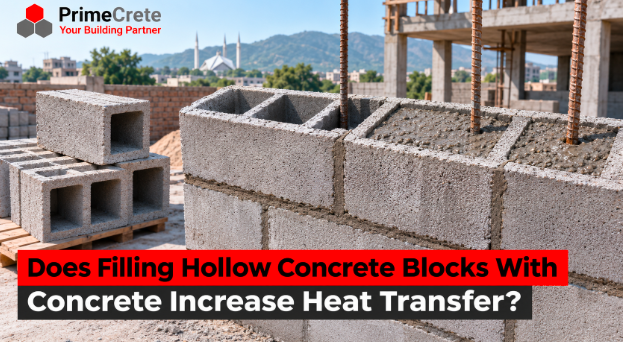
Hollow concrete blocks are widely used in Pakistan because their internal cavities reduce material weight and offer useful flexibility for structural reinforcement. However, an important question arises when contractors fill those cavities with concrete: does the wall become stronger at the expense of thermal performance?
At PrimeCrete, we believe builders should understand both the structural and thermal consequences of their masonry decisions. Adding more concrete may improve a wall’s engineered load resistance, but additional solid material does not automatically improve its ability to resist heat.
The difference becomes especially important when selecting hollow concrete blocks for residential, commercial, and industrial buildings in Pakistan.
The short answer is yes. Filling hollow block cavities with conventional dense concrete or masonry grout generally increases heat transfer and reduces thermal resistance. The actual change depends on block density, cavity geometry, grout placement, and the surrounding wall assembly.
Understanding that difference helps engineers avoid sacrificing thermal efficiency where additional concrete serves no structural purpose.
Why Does Concrete Filling Change Heat Transfer?
An ordinary hollow concrete block contains solid face shells connected by internal webs. The spaces between these components form vertical cavities, commonly called cores.
Heat can cross a hollow masonry wall through three mechanisms:
- Conduction: Heat travels through concrete shells, webs, mortar joints, and any solid core filling
- Convection: Air movement inside cavities can transfer heat between opposing surfaces
- Radiation: Warm cavity surfaces exchange radiant energy with cooler surfaces
The cavities interrupt some of the continuous pathways that would otherwise carry heat through dense concrete.
When contractors fill these cavities with structural grout, they replace much of the air space with a comparatively conductive cementitious material.
The result is a more continuous path for heat movement through the block.
This effect is called thermal bridging.
Importantly, hollow cavities are not perfect insulation. Their effectiveness also depends on size, orientation, air movement, and the block’s internal geometry.
How Much Thermal Resistance Is Lost After Grouting?
There is no reliable universal percentage for every concrete-filled hollow block.
Research published in the Journal of Building Physics, titled Thermal Resistance of Masonry Walls: A Literature Review, summarizes findings showing that grouting reduced masonry R-values by approximately 3% to 12% in selected block configurations.
The reported reductions varied by density and shape.
| Block configuration | Reported R-value reduction after grouting |
| Normal-density, uninsulated multicore block | 12% |
| Normal-density, two-core block | 10% |
| Normal-density, cut-web block | 7% |
| Lightweight, two-core block | 5% |
| Lightweight, cut-web block | 3% |
Source: Kosny (1995), as summarized in the cited literature review. These are configuration-specific research findings, not guaranteed values for PrimeCrete products or all masonry walls.
One lesson stands out: the effect of concrete filling depends on the block design, not merely the quantity of grout.
A lightweight masonry unit with carefully designed webs may respond differently from a normal-density block containing large continuous cavities.
For homeowners interested in general indoor comfort rather than grout-specific performance, our separate article explains whether hollow concrete blocks keep houses cooler.
Empty, Partially Grouted and Fully Grouted Hollow Blocks
Engineers generally consider three main core configurations when evaluating masonry.
| Wall configuration | Heat-transfer behavior | Main consideration |
| Empty hollow cores | Cavities interrupt solid conduction paths | Lower weight, but convection and radiation remain |
| Partially grouted cores | Local conductive bridges develop around filled cores | Balances engineered reinforcement with unfilled cavities |
| Fully grouted cores | More continuous cementitious pathways | Greater structural capacity where designed, but usually lower thermal resistance |
A fourth approach uses suitable thermal insulation in non-structural cavities.
These configurations should not be treated as interchangeable. A wall requiring reinforcement must meet its structural design regardless of insulation preferences.
A Practical Engineering Example
The National Concrete Masonry Association’s TEK 6-2A: R-Values for Single-Wythe Concrete Masonry Walls provides an informative example.
It evaluates a nominal 203 mm (8-inch) hollow masonry wall made from concrete with a density of approximately 1,682 kg/m³.
The example compares a fully grouted wall with a configuration containing grout in 31% of the wall area and perlite insulation in the remaining 69%.
| Configuration | R-value (m²·K/W) | U-value (W/m²·K) |
| Fully grouted | 0.30 | 3.30 |
| 31% grouted, 69% perlite-filled | 0.56 | 1.79 |
The partially grouted, perlite-insulated wall has significantly greater thermal resistance under these specific assumptions.
To understand what this means, consider 10 m² of wall experiencing a 10°C temperature difference.
Using the simplified steady-state formula:
Heat transfer = U-value × Wall area × Temperature difference
The fully grouted wall would transfer approximately 330 watts under these conditions, compared with 179 watts for the partially grouted, perlite-insulated example.
That difference is meaningful. However, it reflects both reduced grouting and added insulation, not the effect of replacing grout with empty air alone. It is not a measurement of a PrimeCrete wall or a prediction of actual electricity savings.
Why Do Engineers Fill Hollow Concrete Blocks With Concrete?
If dense grout increases heat transfer, why use it?
Because masonry must first perform its intended structural function.
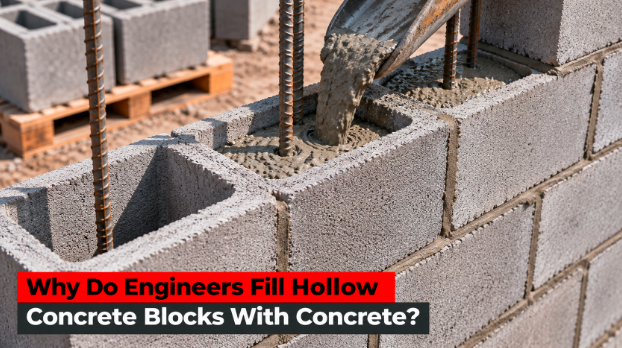
Engineers may specify grout to surround reinforcing steel, increase the capacity of designated masonry elements, or transfer forces through reinforced walls.
Common applications include reinforced wall panels, bond beams, and structurally designed cores.
For example, a reinforced masonry wall in Islamabad may require selected vertical cores to transfer earthquake-related forces through the wall system.
Leaving those cores empty to improve insulation could compromise the structural design.
Conversely, filling every cavity in an ordinary partition without a design requirement may add unnecessary material and weight.
The correct approach is to follow the structural drawings rather than assume every hollow core needs filling.
Our engineering article, Which Hollow Concrete Block Cores Should Be Grouted?, discusses structural core selection separately.
Does More Concrete Mean a Better Insulated Wall?
Not necessarily.
Concrete provides thermal mass, which means it can absorb and store heat. Thermal resistance describes something different: the material’s ability to slow heat flow.
A dense masonry wall can store substantial heat while still conducting it relatively efficiently.
Consider a west-facing wall in Lahore during a hot afternoon.
Sunlight raises the exterior surface temperature. A dense wall absorbs part of that energy, and some heat moves toward the interior.
Depending on wall thickness, weather, and ventilation, the stored heat can continue affecting indoor temperatures after sunset.
More thermal mass may help moderate temperature fluctuations under some conditions, but it does not guarantee a cooler room.
This is why thermal conductivity, thermal resistance, and thermal mass should not be confused.
Builders comparing conventional hollow masonry with fully solid units can review PrimeCrete’s solid concrete blocks, while remembering that structural suitability and thermal performance require separate evaluations.
Can Lightweight Concrete Reduce the Heat-Transfer Penalty?
Yes, suitable lightweight aggregates can improve the thermal resistance of cement-based masonry.
Conventional dense aggregates and porous lightweight aggregates do not conduct heat in the same way.
A lightweight block containing pumice, for example, may provide lower thermal conductivity because the aggregate itself contains numerous microscopic air spaces.
This property can help reduce the conductive effect of the block’s face shells and internal webs.
PrimeCrete manufactures lightweight concrete masonry units using pumice-based materials for applications where reduced weight and thermal performance are important.
However, not every lightweight block has the same strength, density, or thermal resistance.
Designers should request appropriate technical data and confirm that any proposed unit satisfies the project’s structural requirements.
For a broader material-level explanation, read How Lightweight Concrete Masonry Units Reduce Heat in Pakistani Buildings.
Can Hollow Block Cores Be Filled With Insulation Instead?
Yes, provided the selected cores do not require structural grout and the insulation complies with project specifications.
Common insulation approaches include expanded polystyrene inserts, expanded perlite, and other approved masonry insulation systems.
These materials generally have lower thermal conductivity than dense cementitious grout.
However, insulation installed only inside block cavities cannot eliminate heat transfer through concrete webs, mortar joints, columns, and beams.
That is why continuous insulation on the exterior of an engineered wall assembly can offer an important advantage: it reduces the number of conductive paths that bypass the insulation layer.
For grouted structural masonry, the designer should also confirm that the proposed insulation system is compatible with reinforcement, fire requirements, moisture management, and construction detailing.
What Does Pakistan’s Energy Conservation Building Code Require?
Heat-transfer performance matters beyond occupant comfort.
Pakistan’s Energy Conservation Building Code 2023, published by NEECA, identifies an overall external-wall U-value limit of 0.57 W/m²·K in Table 4-1.
This is a whole-wall thermal performance criterion, not a requirement for an individual concrete block.
For projects where the provision applies, engineers must consider the complete wall assembly, including insulation and the effects of structural connections.
The applicable enforcement requirements, building category, and local authority provisions should be confirmed during design.
Simply specifying hollow blocks does not demonstrate compliance.
Neither does specifying fully grouted masonry without a suitable thermal design.
How Should Pakistani Builders Reduce Heat Transfer?
For buildings in Lahore, Islamabad, Karachi, Multan, or other Pakistani cities, the most practical solution is to coordinate structural and thermal requirements before masonry installation.
The following decisions deserve particular attention:
- Confirm the structural grout layout. Identify which cores require filling from approved engineering drawings rather than making decisions on site.
- Review block density and geometry. Two blocks with identical outside dimensions may have different thermal performance because of their internal webs and aggregate composition.
- Evaluate continuous insulation. External insulation can address conductive paths through both masonry and supporting structural elements.
- Consider moisture exposure. Wet masonry can behave thermally differently from dry masonry, so waterproofing and proper detailing remain important.
- Request assembly-level thermal information. Calculate or test the final wall configuration, including finishes, grout, insulation, and structural junctions.
For larger developments, a wall-section thermal calculation can be more useful than choosing materials based on general claims about which block feels cooler.
Frequently Asked Questions
Does filling hollow concrete blocks with cement increase heat transfer?
Generally, yes, when dense concrete or appropriate cementitious masonry grout replaces hollow air cavities. The amount of increase depends on the wall geometry, density, and filling arrangement.
Are partially grouted hollow blocks better than fully grouted blocks?
Partially grouted walls can offer better thermal resistance, depending on their design, while fully grouted walls may be needed for structural capacity. The engineer must determine the required reinforcement and grout arrangement.
Does a concrete-filled hollow block become the same as a solid concrete block?
Not exactly. A grouted hollow unit retains its original face shells, webs, and interfaces between materials. Its thermal and structural behavior may approach some characteristics of solid masonry, but the two should not automatically be assigned identical properties.
Can hollow concrete blocks reduce air-conditioning costs?
A properly designed hollow masonry wall may reduce cooling demand compared with a less thermally efficient alternative. Actual savings depend on the complete building envelope, insulation, roof, glazing, orientation, weather, and air-conditioning system.
Should builders fill all hollow block cores with concrete?
Only when the structural design requires it. Unnecessary grouting can increase material use, dead load, and conductive heat paths without providing a needed structural benefit.
Conclusion: Strength and Insulation Must Be Designed Together
Concrete-filled hollow blocks generally transfer heat more readily than comparable ungrouted hollow blocks, but the thermal penalty is not identical for every masonry system.
A block’s density, core shape, grout distribution, and insulation arrangement influence the final result.
The important question is not whether filling cavities is always good or bad. It is whether each filled core serves a necessary engineering purpose and whether the finished wall satisfies its thermal-performance requirements.
At PrimeCrete, we manufacture precision-molded concrete masonry products at Hattar Industrial Estate, Pakistan. We help contractors, consultants, and project teams select block solutions suited to their construction requirements.
For your next residential or commercial project, share the proposed wall thickness, structural requirements, and thermal performance targets with the PrimeCrete team.
Choose a masonry system based on tested properties and engineering needs, not assumptions about hollow or filled concrete.
Contact PrimeCrete: +92 300 5004275
Website: https://www.primecrete.com.pk/
