
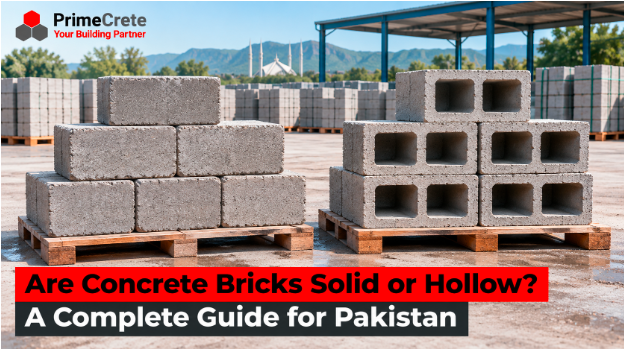
Concrete bricks are generally solid masonry units, but some concrete products have hollow cores or formed openings. The confusion begins when suppliers use the terms concrete bricks, solid concrete blocks, and hollow concrete blocks interchangeably. Although these products share similar ingredients, their internal structures and specifications can differ considerably.
For homeowners, architects, and contractors across Pakistan, understanding these differences prevents expensive material-selection mistakes. At PrimeCrete, we manufacture machine-made concrete masonry products for residential, commercial, and infrastructure construction. Our concrete bricks are designed for applications requiring consistent dimensions, durability, and specified structural performance.
The important question is not simply whether a unit contains holes. It is whether its geometry, tested strength, and intended application match the wall being constructed.
What Are Concrete Bricks Made Of?
Concrete bricks are manufactured from cementitious binders, mineral aggregates, and water. Unlike traditional red clay bricks, they develop strength through cement hydration rather than kiln firing.
Common ingredients include:
- Portland cement or another specified hydraulic cement
- Fine aggregates, such as sand
- Suitable coarse or graded aggregates
- Water for hydration and workability
- Approved admixtures, when required
Manufacturers proportion these materials, place the mixture into moulds, and compact it using mechanical pressing or vibration.
Controlled curing then allows the cementitious mixture to develop strength.
At PrimeCrete’s manufacturing facility in Hattar Industrial Estate, machine-based production helps maintain dimensional consistency and controlled compaction.
However, manufacturing technology alone cannot establish a product’s compressive strength. Laboratory testing must verify the actual performance of each specified product.
Are Concrete Bricks Solid or Hollow?
Standard concrete building bricks are classified as solid masonry units under ASTM C55. They generally have a compact cross-section rather than the large, continuous internal cavities commonly found in hollow concrete blocks.
The distinction matters because the word solid describes a particular masonry classification. It does not necessarily mean that every surface must be perfectly flat or that every small indentation is prohibited.
A brick may feature a shallow depression or surface texture intended to improve mortar contact without becoming a hollow block.
The international ASTM C55-25 specification covers solid, dry-cast concrete building bricks used in structural masonry.
Hollow and solid dry-cast concrete masonry blocks fall within a different specification, ASTM C90, when they meet its requirements.
Therefore, when a Pakistani supplier advertises hollow concrete bricks, buyers should confirm whether the products are genuine brick-sized units or larger hollow concrete masonry blocks marketed using informal terminology.
The product name alone is not enough to establish its classification.
Concrete Bricks vs Hollow Concrete Blocks: What Is the Difference?
Imagine ordering 5,000 concrete bricks for a boundary wall and receiving large masonry units with two open cavities.
Both products contain concrete, but they are not necessarily interchangeable.
Their dimensions, handling requirements, mortar joints, and engineering properties may differ.
| Feature | Solid Concrete Bricks | Hollow Concrete Blocks |
| Internal structure | Predominantly solid | Engineered hollow cores |
| Typical format | Smaller, brick-sized units | Generally larger masonry units |
| Unit weight | Depends on size and density | Reduced by cavities relative to an otherwise comparable solid unit |
| Reinforcement space | No large continuous cores | Some cores can accommodate reinforcement and grout |
| Installation | More units may be needed per wall area | Larger units can reduce joint counts |
| Structural use | Possible with appropriate design | Possible with appropriate design and suitable units |
The most important distinction is that hollow does not automatically mean non-load-bearing.
Engineered hollow masonry can carry structural loads when its strength, reinforcement, connections, and wall design satisfy project requirements.
For a deeper block-specific comparison, read our guide to solid concrete blocks vs hollow blocks.
Why Do Some Concrete Masonry Units Have Hollow Cores?
Hollow cores serve engineering and construction purposes. They are not simply spaces left behind to save cement.
1. Reducing Wall Weight
A hollow unit generally contains less concrete than an otherwise equivalent solid unit of the same external dimensions and mix density.
This reduces its weight and can lower the dead load transferred to structural supports.
For multi-storey buildings, wall weight matters because beams, columns, and foundations must accommodate permanent and variable loads.
However, any reduction in structural member sizes requires engineering calculations.
2. Providing Reinforcement Space
Selected hollow cores can accommodate vertical steel reinforcement and grout where the structural design requires reinforced masonry.
This is particularly relevant when walls must resist lateral forces.
The reinforcement arrangement must follow approved engineering drawings. Simply inserting steel bars into empty cores does not create a properly reinforced wall.
3. Changing Thermal Performance
Air cavities can affect heat transfer through a masonry wall.
However, hollow construction does not automatically guarantee cooler interiors.
Thermal performance also depends on aggregate density, wall thickness, cavity arrangement, plaster, insulation, solar exposure, and other wall components.
For Pakistan’s hot summers, evaluating the complete wall assembly is more useful than comparing bricks by appearance.
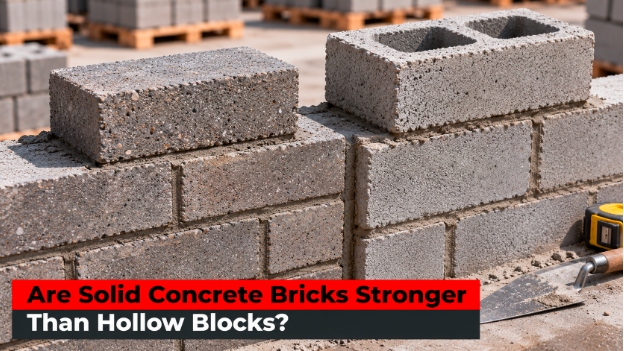
Are Solid Concrete Bricks Stronger Than Hollow Blocks?
Not necessarily.
A common construction myth suggests that heavier masonry must always be stronger.
In practice, compressive strength depends on several factors:
- Cementitious mix proportions
- Aggregate properties
- Compaction and curing
- Unit geometry and density
- Manufacturing quality
- Laboratory testing conditions
A hollow concrete block manufactured to an appropriate load-bearing specification may perform better than a poorly manufactured solid brick.
Equally, a properly specified solid brick may be suitable for applications where an unsuitable hollow unit would fail.
Engineers must distinguish between gross-area strength and net-area strength. Hollow units have less actual concrete bearing area than their overall cross-section suggests.
The relevant test procedure determines how the reported strength should be interpreted.
The ASTM C90-24a specification addresses dry-cast hollow and solid load-bearing concrete masonry units.
Neither standard should be treated as automatic proof that a particular product complies. Buyers need supporting test evidence.
Can Solid Concrete Bricks Support Load-Bearing Walls?
Concrete bricks can be used in load-bearing masonry when the complete wall system is engineered for the intended loads.
The engineer must consider much more than the individual brick’s crushing strength.
Important factors include wall thickness, masonry strength, mortar quality, building height, openings, lateral forces, and foundation support.
This distinction is especially important in Pakistan, where many residential buildings use reinforced cement concrete (RCC) frames with masonry infill.
A wall inside an RCC frame may primarily divide spaces rather than support floor loads. Nevertheless, the wall still requires suitable connections and consideration of structural movement.
For detailed discussion of structural loading, see our article on whether concrete bricks can support RCC slabs.
Do not assume that a brick is approved for structural use solely because it is solid, machine-made, or advertised as high-strength.
How Can You Identify a Solid or Hollow Concrete Unit?
Before ordering masonry products in Pakistan, ask the supplier for a sample and technical information.
Start with a visual inspection.
Examine the cross-section. A predominantly solid unit will not have the large continuous openings commonly associated with hollow blocks.
Measure the dimensions. Confirm the actual length, width, and height. Do not rely on informal descriptions such as standard brick or eight-inch block.
Check the product designation. Ask whether the unit is a concrete building brick, solid concrete block, or hollow concrete masonry unit.
Request the test documentation. The report should identify the product, test method, dimensions, and compressive strength results.
Inspect representative units. Look for significant cracks, broken edges, inconsistent shapes, or other defects that could affect installation and performance.
A simple tapping test cannot reliably determine compressive strength. Laboratory results provide more meaningful evidence.
Which Concrete Masonry Product Should You Choose in Pakistan?
Different projects require different masonry solutions.
For Brick-Sized Masonry Construction
Choose appropriately specified concrete bricks when the design requires brick-sized units, consistent dimensions, and the intended masonry appearance.
For Larger Solid Masonry Units
Solid concrete blocks may suit projects requiring larger units with predominantly solid sections, subject to structural design and testing.
For Reduced Weight and Engineered Cavities
Hollow concrete blocks can be considered where reduced wall weight, larger unit dimensions, or reinforced cores offer project-specific advantages.
For projects in Islamabad, Rawalpindi, Lahore, Karachi, or other Pakistani cities, material selection should also consider weather exposure, transportation distance, and site-handling conditions.
A masonry unit that looks economical at the factory may become less attractive after delivery, installation, cutting, mortar, and finishing costs are included.
For detailed purchasing considerations, see our guide to concrete bricks prices in Pakistan.
What Should Buyers Confirm Before Placing a Bulk Order?
Whether purchasing bricks for a house or ordering masonry products for a commercial development, request these details before approving the material:
- Product classification: Confirm whether the units are solid concrete bricks, solid blocks, or hollow blocks.
- Dimensions: Check nominal and actual dimensions against the drawings.
- Compressive strength: Obtain relevant laboratory results for the proposed product.
- Applicable standards: Identify the specification required by the project.
- Water absorption: Review moisture-related performance where relevant.
- Manufacturing consistency: Check dimensions and visible defects across representative units.
- Delivery conditions: Confirm quantity, handling arrangements, and breakage procedures.
For structural applications, submit the product data to the responsible engineer before construction.
Frequently Asked Questions
Are all concrete bricks completely solid?
Concrete building bricks covered by ASTM C55 are classified as solid. Minor surface features do not necessarily change that classification. Other products marketed informally as concrete bricks may have different geometries, so always check the actual specification.
Do concrete bricks have holes like red clay bricks?
Some masonry products contain perforations or cavities, but these must not be assumed to fall under the same specification as solid concrete building bricks. Check the cross-section and manufacturer’s product designation.
Are hollow concrete blocks weaker than solid concrete bricks?
Not automatically. Strength depends on unit design, materials, manufacturing quality, and testing. Hollow units can be suitable for load-bearing applications when properly specified and engineered.
Are concrete bricks suitable for boundary walls?
Yes, appropriately specified concrete bricks can be used for boundary walls. Wall height, foundations, wind loads, seismic demands, and reinforcement requirements must be considered.
Are concrete bricks better than traditional clay bricks?
Neither material is universally better. Concrete and clay bricks have different manufacturing processes and material properties. Buyers should compare verified strength, dimensions, water absorption, durability, and installed cost.
Can hollow concrete units be used for house construction in Pakistan?
Yes, suitable hollow concrete blocks can serve structural or nonstructural functions. Their use depends on the building design, applicable standards, and verified material properties.
Conclusion
Concrete bricks are generally solid, particularly when they are specified as concrete building bricks under ASTM C55. Hollow concrete masonry blocks are a related but distinct product category, even when suppliers use similar names.
The best construction choice depends on more than whether a brick has holes. Dimensions, tested strength, weight, wall design, and installation quality determine whether a masonry product meets the project’s requirements.
At PrimeCrete, we manufacture concrete masonry products for residential, commercial, and infrastructure applications in Pakistan. Our team can help contractors and developers review product specifications and identify suitable masonry options.
Planning a construction project? Contact PrimeCrete with your required dimensions, wall application, and technical specifications to discuss the appropriate concrete masonry product.
