
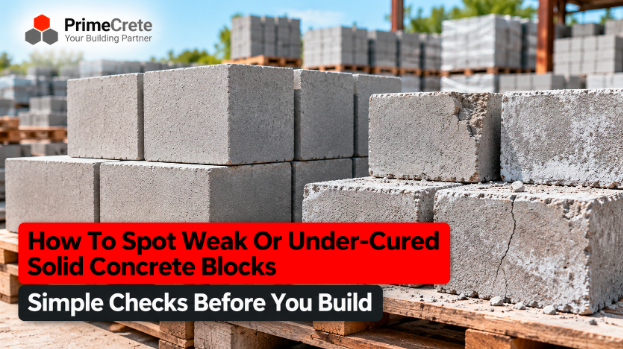
A block wall can look perfect on day one. So can a sandcastle. The real test comes months later, when the load arrives, the monsoon hits, and every weak unit starts telling on itself. That’s why it pays to check your solid concrete blocks before a single one goes into the wall.
At Prime Crete, we make concrete blocks every day, so we know exactly what separates a good unit from a bad one. This guide shows you how to spot weak concrete blocks, why curing matters so much, and when you should stop guessing and ask for a lab test.
Why Curing Makes or Breaks a Concrete Block
Most weak blocks don’t fail because of bad luck. They fail because someone rushed the curing.
What Curing Actually Does
The American Concrete Institute (ACI 308R) describes curing as keeping fresh concrete at the right moisture and temperature long enough for cement hydration to happen, so the mix can reach its full strength and durability.
In plain words, cement needs water to harden properly. Take the water away too early, and the chemistry simply stops.
What Happens When Blocks Skip Curing
According to the American Cement Association, the longer concrete stays moist, the stronger and more durable it becomes. Most of its hydration and strength gain happens in the first month.
Here’s the painful part. The Portland Cement Association notes that if moist curing stops and later restarts, strength gain resumes, but the concrete may never reach its original potential. Think of it like skipping a whole semester and cramming the night before the exam. You might pass. You probably won’t top the class.
The American Cement Association’s guide to curing explains the process in more detail if you want to go deeper.
What Strength Should a Good Block Have?
Before you judge a block, you need a benchmark. Under ASTM C90, the standard for loadbearing concrete masonry units, the minimum net-area compressive strength is 2,000 psi (13.8 MPa), measured using the test methods in ASTM C140.
That number is a floor, not a target. Structure magazine points out that manufacturers typically produce units 20 to 30% stronger than this minimum.
The Concrete Masonry & Hardscapes Association (CMHA) publishes a clear breakdown of these requirements. For a buyer’s checklist, read our guide on solid concrete block specifications and what to check before buying.
6 Signs of Weak or Under-Cured Solid Concrete Blocks
You don’t need a laboratory to raise a red flag. Your eyes, ears and fingernails can do a surprising amount of work. Just remember: these are warning signs, not final verdicts.
1. Edges and Corners Crumble Easily
A well-cured block holds sharp, firm edges. If corners chip off during unloading, or break when you rub them with your thumb, the concrete hasn’t bonded properly. Good blocks survive a truck ride. Weak ones arrive as gravel.
2. The Surface Feels Dusty or Powdery
Run your hand across the face. If grey powder coats your palm, take note. Good curing reduces surface dusting, craze cracking and shrinkage, so a chalky finish often hints that the block dried out too fast.
3. It Sounds Dull When You Tap It
Knock two blocks together gently, or tap one with a small hammer. Dense, well-cured concrete usually gives a clear, solid ring. A dull thud can point to low density or poor compaction. Treat this as a quick field clue, not proof.
4. It Scratches Too Easily
Drag a steel nail or key across the surface. Sound concrete resists and leaves only a faint line. If the nail digs a deep groove with little effort, the block may lack strength.
5. You Can See Hairline Cracks Before Laying
Cracks on a brand-new block are never a good sign. When concrete loses too much water early, it shrinks and builds tensile stress. Surface cracking follows if that stress arrives before the concrete is strong enough. In short, early cracks often trace back to rushed curing.
6. It Drinks Water Too Fast
Splash a little water on the block. If it vanishes instantly and the block darkens deeply, the concrete may be porous. Absorption measures the total water needed to fill the voids in a unit, and CMU specifications set upper limits on it. Our post on water absorption and strength tests for concrete blocks in Pakistan explains how proper testing works.
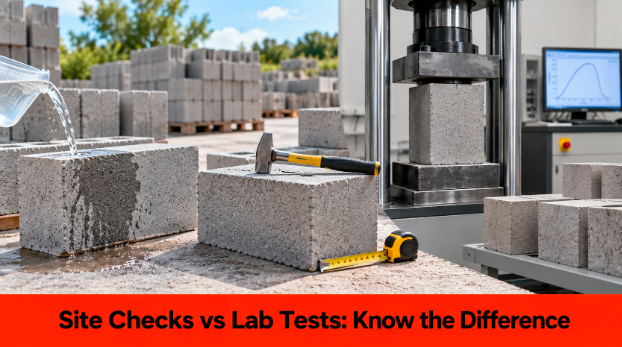
Site Checks vs Lab Tests: Know the Difference
What Site Checks Can Tell You
Site checks help you sort obvious rejects from the rest. They cost nothing and take minutes. Pick a few blocks at random from different pallets, not just the neat ones on top.
When You Need a Lab Test
Site checks can’t give you a strength number. Only a proper compressive strength test can do that. Ask for a lab test when:
- The blocks will carry structural loads
- Several blocks fail your site checks
- The supplier can’t show a recent test report
- You’re building foundations, basements or multi-storey walls
A test report costs far less than tearing down a wall. Your structural engineer will agree, and so will your wallet.
How to Avoid Buying Under-Cured Blocks
Prevention beats demolition every time. Before you place an order, run through this list:
- Ask for the production date. Fresh-off-the-machine blocks haven’t had time to cure. Ask how long the supplier cures them before dispatch.
- Ask about the curing method. A reliable manufacturer will explain it without hesitation.
- Request a compressive strength report. Check which standard the supplier tests against.
- Match the block to the job. Load-bearing walls need different units than partitions. Compare our load-bearing and non-load-bearing blocks, or consider hollow concrete blocks for lighter internal walls.
- Inspect on delivery. Check a sample before the truck leaves, not after the mason starts laying.
The Bottom Line
Under-cured concrete blocks rarely look dramatic. They look ordinary, and that’s exactly the problem. A chipped corner, a dusty face or a suspiciously thirsty surface can reveal what the block won’t say out loud.
Use your senses on site. Ask your supplier the right questions. And when the wall matters, back your judgement with a lab test.
Strong walls start with strong blocks. Choose solid concrete blocks that come with proper curing, clear specifications and test results you can actually see.

[…] surface that flakes under impact. If you want to know what bad curing looks like, our guide on how to spot weak or under-cured solid concrete blocks covers the warning signs, and most of them apply to kerbs […]
[…] for cracks, broken corners and uneven sizes before you sign the delivery note. Our guide on how to spot weak or under-cured solid concrete blocks walks you through the warning […]
[…] Rushing this stage is like pulling a cake out of the oven halfway through. It looks fine on top and disappoints underneath. If you want to see what weak curing looks like in practice, read our guide on how to spot weak or under-cured concrete blocks. […]
[…] that skipped proper curing won’t reach its rated strength, whatever its weight. Our guide on how to spot weak or under-cured solid concrete blocks shows the warning signs, and most of them apply to lightweight units […]
[…] often skip proper curing. They look fine on day one, then crumble on day ninety. Our guide on how to spot weak or under-cured concrete blocks shows the warning […]
[…] block you pick, quality still decides the outcome. Our guide on how to spot weak or under-cured solid concrete blocks shows you the warning signs before they end up buried in your foundation. And if you wonder what […]
[…] strength test results, not just a visual check. Under-cured units absorb more water, so learn how to spot weak or under-cured solid concrete blocks before you accept a […]