

A concrete block wall looks tough enough to ignore almost anything. Rain, heat, dust, and the occasional football usually do not worry it much. Salt and groundwater, however, deserve more attention. They can move through porous masonry, leave deposits behind, and, under certain conditions, contribute to real deterioration.
At PrimeCrete, we believe durability starts with understanding what a material will face after construction, not simply how strong it looks on delivery day. Well-made solid concrete blocks can provide durable wall construction, but good blocks still need correct detailing, drainage, waterproofing, and protection from aggressive ground conditions.
How Does Groundwater Reach a Concrete Block Wall?
Concrete looks solid, but at a microscopic level it contains pores. Water can move through these pores and through mortar joints, cracks, poorly sealed surfaces, or sections of masonry that remain in contact with wet soil.
This becomes especially important around:
- Foundations
- Basement walls
- Retaining walls
- Boundary walls
- Plinth-level masonry
- Landscaping walls
- Areas with poor drainage
The Concrete Masonry & Hardscapes Association explains that masonry touching soil can absorb groundwater containing soluble salts. Through capillary action, that moisture can carry salts upward through the masonry.
Think of the wall as a very slow straw. It will not empty your garden overnight, but given enough moisture and time, water can travel surprisingly far.
What Happens When Salt Enters Solid Concrete Blocks?
Not every salt causes the same problem, and not every white mark means the wall is failing.
Two conditions need to be separated: efflorescence and chemical deterioration such as sulfate attack.
Efflorescence: The White Powder on the Wall
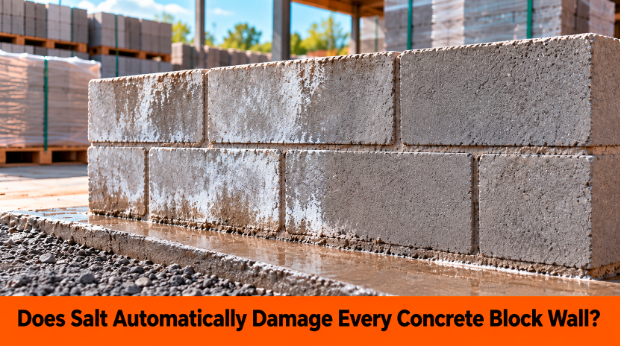
Efflorescence happens when water dissolves soluble salts inside masonry, carries them toward the surface, and then evaporates. The salts remain behind as white or pale deposits.
CMHA identifies three ingredients needed for efflorescence:
- Soluble compounds must exist
- Moisture must dissolve and transport them
- Evaporation or pressure must move the solution toward the surface
The reassuring part is that ordinary efflorescence usually affects appearance rather than structural performance. CMHA specifically notes that efflorescence itself does not normally reduce masonry’s structural performance.
So, if your wall develops a white powder, do not immediately start planning its funeral.
You should still investigate the moisture source, especially if deposits keep returning.
For more information about block quality and water movement, PrimeCrete’s guide to water absorption and strength tests for concrete blocks explains why absorption and density matter in masonry selection.
Can Groundwater Cause More Serious Concrete Damage?
Yes. The more serious issue starts when groundwater contains chemically aggressive substances, particularly sulfates.
What Is Sulfate Attack?
Sulfate attack occurs when sulfate ions enter susceptible concrete and react with components of the hardened cement paste.
The process can create expansive reaction products inside the concrete. As these products form, internal stresses can increase. Over time, affected concrete may show cracking, softening, surface loss, expansion, or deterioration.
Research published through the American Concrete Institute has documented sulfate-bearing groundwater penetrating highly permeable concrete and producing sulfate-related changes within the material.
NIST also describes sulfate attack as a potentially serious deterioration mechanism in concrete exposed to sulfate-containing soil or groundwater, noting that severe cases can cause cracking and even disintegration.
For technical background, see the NIST research on concrete durability and sulfate attack.
Does Salt Automatically Damage Every Concrete Block Wall?
No.
Finding salt in groundwater does not mean a solid concrete block wall will automatically fail.
Risk depends on several factors, including:
- Type and concentration of salts
- Length of exposure
- Concrete permeability
- Block density
- Cementitious materials
- Cracks and mortar-joint quality
- Drainage conditions
- Waterproofing
- Repeated wetting and drying
Dense, properly manufactured concrete generally allows less water movement than highly porous concrete. That matters because aggressive chemicals need moisture as their transport system.
A strong-looking block with high permeability can sometimes face more durability trouble than expected. Concrete chemistry has a habit of reminding us that appearances are not laboratory results.
Before selecting masonry, it therefore makes sense to review actual solid concrete block specifications rather than choosing units based only on weight or appearance. PrimeCrete’s guide on what to check before buying solid concrete blocks covers important specification considerations.
How Can You Protect Concrete Block Walls From Groundwater?
Preventing moisture movement is usually more effective than repeatedly cleaning the symptoms.
Improve Site Drainage
Water should move away from walls and foundations instead of collecting beside them.
Correct grading, drainage systems, functioning gutters, and appropriate foundation drainage can reduce prolonged contact between masonry and groundwater.
Use Correct Damp-Proofing or Waterproofing
Below-grade masonry may need a properly specified waterproofing or damp-proofing system.
The correct system depends on groundwater conditions, soil, wall design, hydrostatic pressure, and the intended use of the structure.
A coat of random black paint is not automatically a waterproofing design.
Control Water Entry Through Wall Details
CMHA recommends controlling moisture through good wall design, flashing, joint detailing, sealants, drainage, and appropriate water-repellent treatments.
You can read its detailed guidance on control and removal of efflorescence in concrete masonry.
Choose Quality Concrete Masonry Units
Manufacturing consistency matters.
Dense, well-compacted masonry with controlled absorption provides a better starting point for durable construction than poorly compacted or under-cured units.
If your project calls for a different wall system, PrimeCrete also produces hollow concrete blocks for load-bearing and non-load-bearing applications. Product selection should always match the structural design and exposure conditions.
What Should You Do If White Salts Already Appear?
First, identify the moisture source.
Cleaning the wall while groundwater continues feeding moisture into it is a bit like drying the kitchen floor while leaving the tap running.
For light efflorescence, CMHA recommends starting with relatively gentle cleaning methods such as dry brushing where appropriate. More aggressive cleaning should only follow after identifying the type of deposit and correcting the moisture problem.
Avoid assuming that every stain needs acid treatment or high-pressure washing. Incorrect cleaning can damage the masonry surface or push additional water into the wall.
When Should an Engineer Investigate the Wall?
White surface deposits alone do not necessarily indicate structural damage.
Get professional advice when you see signs such as:
- Growing cracks
- Surface scaling or spalling
- Soft or crumbling masonry
- Persistent dampness
- Significant movement
- Repeated salt deposits after repairs
- Damage concentrated near foundations or retaining walls
An engineer may recommend testing groundwater or soil chemistry if sulfate exposure appears possible.
The block itself should also be checked. PrimeCrete’s article on how to spot weak or under-cured solid concrete blocks explains why curing and manufacturing quality affect long-term durability.
Can Solid Concrete Blocks Handle Salty or Wet Conditions?
Solid concrete blocks can perform well in demanding construction, but durability depends on more than compressive strength.
Groundwater supplies moisture. Salts travel with that moisture. Some salts simply produce visible efflorescence, while aggressive sulfate exposure can contribute to genuine concrete deterioration under the right conditions.
The practical answer is straightforward: choose quality blocks, control water movement, provide suitable drainage and waterproofing, and investigate unusual deterioration instead of covering it with another coat of paint.
Concrete is strong. It is not magic.
A well-designed wall manages both structural loads and environmental exposure, which is what gives concrete masonry its best chance of performing reliably for years.
