
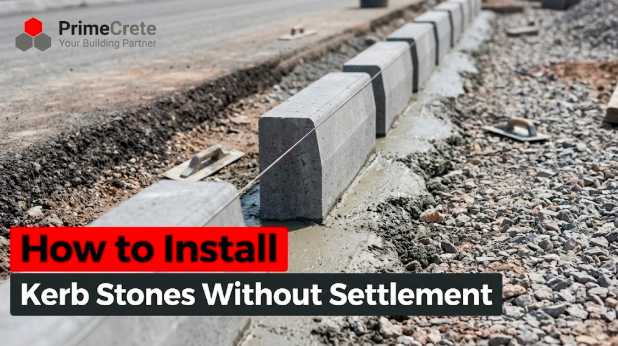
A new housing-society road in Rawalpindi looks sharp on inauguration day. One monsoon later, the kerbs along the drain side have dropped, leaned outward and opened gaps you could post a letter through. The kerb stones themselves are fine. The ground and the concrete that were supposed to hold them were not.
At PrimeCrete, we manufacture kerb stone blocks for roads, parking areas, footpaths, landscaping and drainage edges. This guide explains why kerbs settle, how to build a proper foundation and haunch, and the step-by-step installation practice that keeps kerbs straight and level for years in Pakistani conditions.
The Short Answer
To install kerb stones without settlement, set them on a firm, compacted formation and a continuous concrete foundation, then support the back with concrete haunching placed while the bed is still fresh. UK highway details commonly call for at least 150 mm of concrete under the kerb on new work, with the bed and backing laid in one operation. Good drainage, proper compaction behind the kerb and curing complete the job.
Why Kerb Stones Settle
A kerb stone is a precast concrete edge unit that separates the carriageway from footpaths or verges, guides water to drains and acts as an edge restraint for paving. It only works when the ground and concrete around it stay put. Settlement usually comes from one or more of these causes:
- Soft or loose formation. Kerbs laid on fill, rubble or wet clay sink as that material compresses under traffic.
- No concrete foundation. Kerbs bedded on sand or soil alone have nothing stiff to spread the load.
- Missing or thin haunch. Without concrete behind the kerb, wheel impacts and soil pressure push it outward.
- Cold joints. A bed that sets hard before the haunch goes on does not bond to it, leaving a weak plane.
- Water. Monsoon runoff scours unprotected soil behind and under the kerb, especially near drains.
- Traffic abuse. Water tankers and delivery trucks mounting kerbs at gates and corners apply loads far above design.
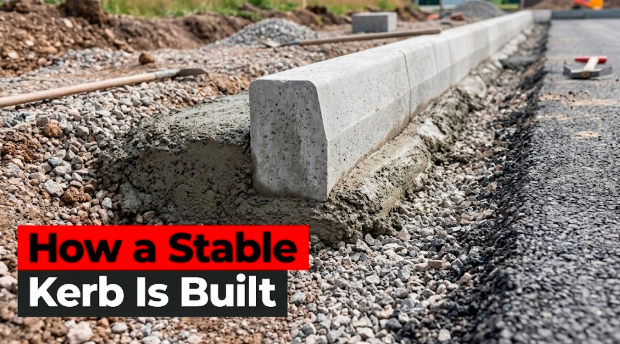
How a Stable Kerb Is Built
| Layer | Purpose | Typical practice |
| Formation and sub-base | Firm support | Remove soft spots; compact in layers |
| Concrete foundation (bed) | Spreads load, stops sinking | At least 150 mm deep on new work in many UK details |
| Mortar bed or fresh concrete | Sets the kerb to line and level | Kerb bedded on mortar or on still-plastic concrete |
| Concrete haunch (backing) | Holds the kerb against outward push | Placed with the bed, before it sets |
| Backfill and paving | Locks the system | Compacted behind; pavers abut the kerb face |
Hertfordshire County Council’s kerb construction notes set a minimum of 150 mm of concrete under the kerb on new construction, require the bed and backing to be laid in one operation and call for kerbs to be closely butted to their neighbours. Its notes also say that, where footways use block pavers, the kerb and backing must sit high enough to leave room for the specified bedding sand layer.
Step-by-Step: Installing Kerb Stones Correctly
- Set out line and level. Fix pegs and tight string lines for both alignment and top-of-kerb level, including the drainage fall toward outlets.
- Excavate to firm ground. Dig the trench wide enough for the bed and haunch. Remove soft, organic or waterlogged material and replace it with compacted granular fill.
- Compact the formation. Use a plate compactor in thin layers. A kerb never outperforms the soil under it.
- Place the concrete foundation. Pour the bed to the specified depth, commonly at least 150 mm, along the full run.
- Bed the kerbs. Lay each unit on a mortar bed or directly onto the still-plastic concrete. Tap it down to the string line, checking line and level every few units.
- Haunch immediately. Place backing concrete behind the kerb while the bed is fresh so the two act as one. The Highland Council’s precast kerb details require haunching concrete to go in within one hour of laying the bed.
- Form joints properly. Butt units closely, and carry movement joints through the backing where the adjacent concrete pavement has joints.
- Cure and protect. Keep the concrete damp and keep vehicles off until it gains strength. In a Multan or Lahore summer, fresh concrete can lose water fast, so cover it and wet-cure.
- Backfill and compact. Compact soil or sub-base behind the haunch in layers before laying footpaths or verges.
On a well-run site, a kerb line checked with a 3 m straightedge should look boringly straight. Many highway specifications set tight tolerances, such as ±6 mm on level, so measure rather than eyeball.
Units matter too. Learn how much concrete support kerb stones need for different traffic, and check the units themselves for consistent dimensions, sound edges and verified strength.
Pakistan-Specific Risks to Plan For
- Monsoon scour. Protect soil at kerb ends, drain inlets and outfalls. Water running along the back of a kerb can wash away support within one season.
- Housing-society fill. Many plots and roads sit on recently placed fill. Test and compact it, or dig below it to firm ground.
- Heavy vehicles at gates. Use dropped or heavy-duty kerbs at access points rather than expecting standard kerbs to survive tanker wheels.
- Curves. Tight radii need curved units or short straights; long straight units forced around bends leave gaps. See how to choose kerb stones for curved roads.
Common Mistakes to Avoid
- Laying kerbs on sand alone to save concrete. It saves money once and costs it again within a year.
- Haunching the next day. The bed has already set, so the haunch never bonds to it.
- Skimpy haunch. A thin triangle of concrete cannot resist outward thrust from vehicles and soil.
- No drainage path. Ponding water behind the kerb softens the ground beneath it.
- Opening to traffic too early. Green concrete cracks and lets the kerb rotate.
Before You Hand Over: Inspection Checklist
- Line straight and level to the string and straightedge
- Concrete bed and haunch visible and continuous at trench ends
- Joints tight and even, with no rocking units
- Falls carry water to the outlets without ponding
- Backfill compacted and finished, not left loose
Frequently Asked Questions
Can kerb stones be laid on sand?
For light garden edging, sometimes. For roads, parking areas and driveways, kerbs need a concrete foundation and haunch to resist traffic and soil pressure.
How deep should the concrete under a kerb be?
Many UK highway details set a minimum of 150 mm on new construction. Your project engineer should confirm depth based on soil and traffic.
Why do kerbs lean outward?
Usually because the haunch is missing, too small or poorly bonded, or because water has softened the soil behind the kerb.
When can traffic use new kerbs?
After the bed and haunch concrete have cured enough to carry load. Follow the project specification and keep heavy vehicles away longest.
Conclusion
Kerb settlement is almost always a foundation problem, not a kerb problem. Build on firm, compacted ground, use a continuous concrete bed, place the haunch while the bed is still fresh, cure it properly and keep water from undermining the line. With those basics right, good kerb stones stay straight for many years. PrimeCrete can help contractors, housing societies and developers choose kerb stone sizes and quantities for road and parking projects across Pakistan.
