
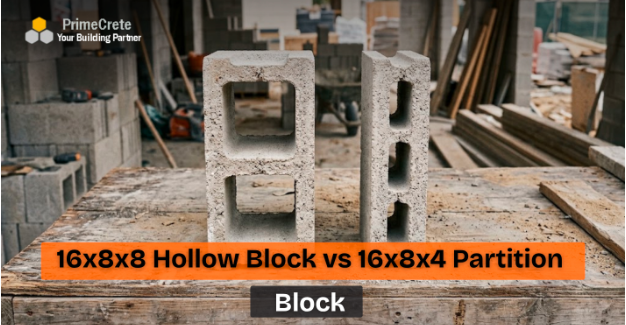
On most Pakistani drawings you will see two hollow sizes side by side: the 16x8x8 hollow block for walls and the 16x8x4 partition block for rooms. They share the same face size, so they look related. They do not do the same job.
This article explains the difference in plain language so a homeowner, contractor, or quantity surveyor can pick the right unit before the order goes to the plant.
What Each Size Actually Means
Both units are hollow concrete blocks. Cores run through the height. That keeps weight down and leaves air inside the wall. The difference is thickness.
16x8x8 Hollow Block
This is the standard 8-inch wall block used across Pakistan. The usual reading is 16 inches long, 8 inches high, and 8 inches thick. After mortar and plaster you get a full masonry wall, not a light divider.
It is the size most houses, schools, and commercial infill walls are built with. When a supplier writes 8x8x16, they are usually naming the same module in a different order.
16x8x4 Partition Block
This unit keeps the 16-inch face and 8-inch course height, but the wall is only 4 inches thick. It is made for internal divisions: bedrooms, bathrooms, kitchens, and office cabins.
It saves space and weight. It is not a like-for-like swap for an external 8-inch wall.
Prime Crete produces both types as factory hollow concrete blocks at Hattar Industrial Estate, about 25 km from Islamabad, on Masa Germany plant. When a drawing needs a denser unit for a plinth or heavy wall, the same works also supplies solid concrete blocks.
Where Each Block Belongs on a Building
Use 16x8x8 for Walls That Work Harder
Choose the 16x8x8 hollow block when the wall must do more than split a room:
- External walls of houses and low-rise buildings
- Infill panels between RCC columns and beams
- Boundary walls specified as 8 inches
- Load-bearing masonry where the engineer has designed for it
- Walls that will take window frames, heavy doors, or services
The extra thickness gives a wider bed for mortar, more face-shell material, and space to drop vertical bars and grout if the detail calls for it. Heat and sound also move more slowly through an 8-inch hollow wall than through a 4-inch leaf, provided joints are full.
Use 16x8x4 for Rooms and Light Divisions
Choose the 16x8x4 partition block when the wall only divides space:
- Internal room partitions
- Toilet and wet-area divisions
- Kitchen walls that will take tiles
- Cabin and corridor walls in offices
- Non-load-bearing infill where floor area is tight
A 4-inch wall gives back usable space on both sides of a room. It is lighter to lift on upper floors. It uses less mortar for the same wall face. Fixings for heavy cabinets still need packing, timber grounds, or a local solid patch. Do not hang large wall units on a thin hollow leaf without a detail.
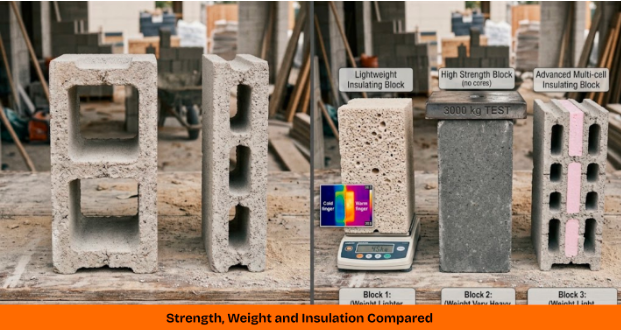
Strength, Weight and Insulation Compared
Load Path
An 8-inch hollow unit has more concrete in the face shells and webs. That is why it is the default for walls that may carry floor loads or wind on a long elevation. A 4-inch partition is built to stand as a divider. If someone later asks that partition to carry a slab edge or a water tank, the wall is being asked to do work it was not bought for.
Factory units should still be tested. Prime Crete work is checked against ASTM C90, ASTM C129 and BS 6073, as noted on the company profile. Strength on paper matters only when size and use also match the drawing.
Handling on Site
Both sizes share an 8-inch course height, so masons can keep one string line when a 4-inch partition meets an 8-inch wall at a junction. The 4-inch unit is lighter. The 8-inch unit is still lighter than a solid block of the same thickness, which is why hollow masonry is preferred for speed.
Heat, Sound and Fire Path
Air in the cores helps both sizes. The 8-inch wall simply has more mass and a longer path through the leaf. For a bedroom next to a generator room or a west-facing external wall in Punjab or Khyber Pakhtunkhwa heat, the thicker hollow block is the more comfortable choice. For a short internal wall between two air-conditioned rooms, the 4-inch unit is usually enough.
Fire rating depends on thickness, cores, plaster, and openings. Do not assume a 4-inch partition matches an 8-inch wall on a fire compartment line.
Cost, Quantity and Mortar
How Many Blocks You Need
The face of both blocks is 16 inches by 8 inches. Estimators often use about 1.125 blocks per square foot of wall face, then add 5 to 10 percent for cuts and breakage. One hundred square feet of wall face is often taken as about 113 blocks before wastage. Thickness changes the wall’s strength and mortar volume, not the count of faces.
What Changes the Bill
Local market notes in 2025–2026 often placed 16x8x8 hollow units around PKR 180–220 each and 16x8x4 units around PKR 95–130 each. Those bands move with cement, diesel, and city. A tested factory block can sit above a yard-made copy and still cost less in plaster and rework.
Mortar use drops on hollow work compared with brick, because the unit is larger. A 4-inch wall uses less mortar than an 8-inch wall for the same elevation. Labour is similar per face, but the 8-inch wall takes more mix and more time at openings.
Transport also favours planning both sizes from one plant. Mixed loads from Hattar into Islamabad and nearby cities reduce shortage of one size while the other sits unused.
Junctions, Openings and Common Mistakes
Meeting an 8-Inch Wall with a 4-Inch Partition
The joint needs a clean stop, mesh or ties, and full mortar. Do not tooth a 4-inch leaf randomly into an 8-inch wall and hope plaster hides the crack. Give the mason a detail at the first floor, not after the first crack.
Doors and Frames
An 8-inch wall gives a proper rebate for a heavy door. A 4-inch partition needs a frame designed for that thickness. Thin walls twist if the frame is forced in with excessive packing.
Services
Electrical boxes sit more comfortably in 8-inch work. In 4-inch partitions, chase with care so you do not cut through both face shells. Keep wet services off a thin hollow leaf unless the plumber has a sleeve detail.
The Mistake That Costs Most
Buying only 16x8x4 for a whole house because it is cheaper per piece. External walls then lack thickness, insulation, and fixing strength. The saving disappears in extra steel, extra plaster, or a later rebuild of the outer leaf.
The opposite mistake is using 16x8x8 for every internal wall and losing room area that a partition block would have given back.
Quality Checks That Apply to Both Sizes
Before the truck is unloaded, pull three units from different pallets:
- Length, height and thickness should match the order
- Edges should be sharp
- Cores should be open, not collapsed
- Colour and texture should be even
- Ask for recent compression and water-absorption results
High absorption blocks drink water from the mortar and can show damp later. Size that wanders by more than a few millimetres forces thick joints and uneven plaster.
A short technical note on standard masonry block dimensions is published by Engineering ToolBox. Use it when a consultant writes international CMU sizes and the site is ordering local inch sizes.
How to Write the BOQ Line
Write the size in full, then the use:
- “16x8x8 hollow concrete block, factory made, for 8-inch walls”
- “16x8x4 hollow concrete block, factory made, for internal partitions”
Add the required strength if the engineer has given one. That stops a store from issuing partition blocks to an external wall gang.
For current product notes and plant contact, use the Prime Crete home page. Custom length, density or strength can be discussed before the drawing is frozen.
Quick Answers
Can 16x8x4 replace 16x8x8 on an external wall?
No, not as a direct swap. The 4-inch unit is a partition block.
Are the faces the same height?
Yes. Both are commonly 8 inches high and 16 inches long. Thickness is the difference.
Which size is better for a house in Pakistan?
Use 16x8x8 for outer walls and 16x8x4 for rooms. That mix is what most practical houses need.
Do hollow blocks save money?
They save labour and mortar when the correct thickness is used. The wrong thickness does not.
