
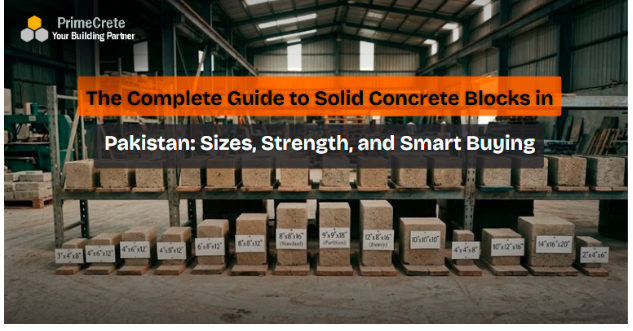
Picking the right block size shapes the strength, cost, and speed of your entire project. Many builders in Pakistan order blocks without checking dimensions closely, and that small oversight leads to weak walls or wasted money. This guide breaks down the standard sizes, when to use each one, and how to match the right block to your job.
Standard Solid Concrete Block Sizes in Pakistan
Solid concrete blocks are dense, gap-free building units made from cement, sand, crushed stone, and water. Because they carry weight so well, they suit everything from boundary walls to load-bearing structures. The good news is that most manufacturers follow a fairly common set of sizes, which makes planning easier.
Across the country, you will usually see three main solid concrete block sizes. Each keeps the same length and height, while the width changes to match the strength your wall needs.
16 × 8 × 4 Inches
This is the slimmest common block. At four inches wide, it works best for lightweight jobs where heavy loads are not a concern. Builders often reach for it when they want to save space and material without sacrificing a clean, tidy wall.
16 × 8 × 6 Inches
The six-inch block sits right in the middle and remains the most popular pick for general construction. It strikes a smart balance between strength, weight, and cost. If you are unsure which size to choose, this one handles a wide range of tasks with ease.
16 × 8 × 8 Inches
The eight-inch block is the thick, heavy-duty option. Its wide body delivers serious strength, so engineers rely on it for structural and load-bearing work. When your wall must stand up to real pressure, this is the block that earns its place.
When to Use Each Block Size
Choosing a size is really about matching the block to the job. A partition wall and a foundation wall face very different demands, so the right width changes with the task.
Best Uses for 4-Inch Blocks
Use the 16 × 8 × 4 inch block for:
- Internal partition walls that divide rooms
- Non-load-bearing walls
- Light garden or decorative dividers
- Spaces where you want to save floor area
Since these blocks carry little structural weight, they keep costs down while still giving you a solid, neat finish.
Best Uses for 6-Inch Blocks
The 16 × 8 × 6 inch block is your all-rounder. It fits:
- Exterior walls in single-story homes
- Boundary walls of moderate height
- Partition walls that need extra sound insulation
- Projects that want strength without heavy weight
Because it balances so many needs, this size shows up on more sites than any other.
Best Uses for 8-Inch Blocks
Save the 16 × 8 × 8 inch block for the tough jobs, such as:
- Load-bearing walls in homes and commercial buildings
- Tall boundary walls that face wind and impact
- Retaining walls that hold back soil
- Foundations and basement walls
If you are building anything that must carry weight or resist force, these solid concrete blocks give you the confidence your structure needs.
How Block Size Affects Strength and Cost
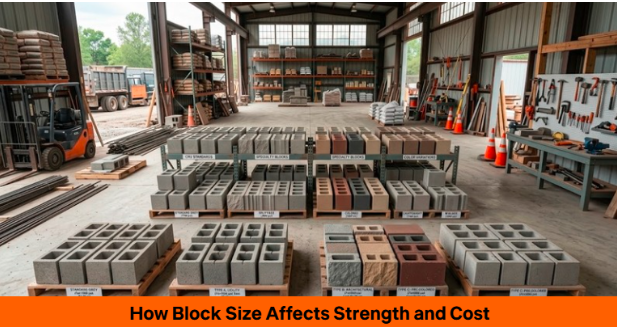
Size does not just change how a wall looks. It directly shapes how strong the wall is and how much you spend.
Strength Grows With Width
A wider block holds more mass, so it resists pressure better. That is why the eight-inch block outperforms the four-inch version in load-bearing tests. Compressive strength matters most here, since it measures how much force a block can take before it cracks. For most homes, blocks rated between 5 and 7 MPa work well, but taller or heavier structures may call for higher grades and wider blocks.
To confirm you are buying the right grade, ask your supplier for test data and compare it against the standards published by the Pakistan Standards and Quality Control Authority. Trusted manufacturers test their blocks often and share the results without hesitation.
Cost Rises With Size
Wider blocks use more material, so they cost more per unit. Yet the story does not end at price per block. Larger blocks cover more area, which means fewer blocks, less mortar, and faster labor. A four-inch block is cheaper upfront, but for a big load-bearing wall, an eight-inch block can save time and reduce joints. Weighing material cost against labor savings helps you spend wisely. Our guide on smart material budgeting walks through this trade-off in more detail
Tips for Choosing the Right Block Size
A little planning here saves you from expensive changes later. Keep these points in mind before you place your order.
Match the Size to the Load
Start by asking what the wall must do. Partition walls rarely need thick blocks, while foundations and tall boundary walls demand them. Matching width to load prevents both under-building and over-spending.
Confirm Exact Dimensions
Small differences between manufacturers can throw off your mortar joints and block count. Always confirm the exact measurements in inches before buying, since even a few millimeters add up across a large wall.
Check Weight and Quality
A block should feel heavy for its size. Light blocks often hide poor compaction or too little cement, both of which weaken the wall. Inspect samples for a smooth surface, uniform shape, and no cracks.S
Plan for Reinforcement
For tall walls built with solid concrete blocks, add proper reinforcement at corners and high sections. The right size paired with good reinforcement gives you a wall that lasts for generations. You can explore the full range of block options to find the exact fit for your project.
Final Thoughts on Picking the Right Size
Getting the size right is half the battle in any strong build. The 16 × 8 × 4 inch block suits light partitions, the 16 × 8 × 6 inch block handles everyday construction, and the 16 × 8 × 8 inch block carries the heavy structural loads. When you match width to purpose, check quality closely, and plan your budget around both material and labor, your project starts on truly solid ground.
