
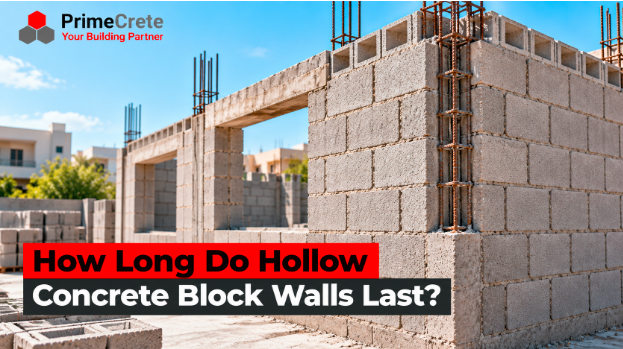
A homeowner building a 10-marla house or a contractor constructing a commercial boundary wall needs to know whether hollow concrete block walls will remain dependable for decades. Properly designed and maintained hollow concrete blocks can form durable masonry walls, but their service life depends on structural design, material quality, water protection, workmanship, and maintenance.
A well-built concrete block wall can remain serviceable for many decades, and 50 years or longer is a reasonable project-life consideration for some buildings-not a universal product guarantee. PrimeCrete, the concrete-products brand of Pak Dream (Pvt) Ltd, supplies manufactured masonry products for construction projects in Pakistan. Understanding which conditions influence durability helps contractors and property owners make better construction decisions.
This article explains hollow block wall lifespan, common deterioration causes, and methods for improving long-term wall performance.
How Many Years Can Hollow Concrete Block Walls Last?
Hollow concrete block walls can last for several decades when engineers design them correctly, contractors install them properly, and owners control moisture and structural deterioration. Their actual service life cannot be determined by block type alone.
A 50-year design-life target should not be confused with a manufacturer’s guarantee that every wall will last exactly 50 years.
Service life depends on the whole masonry assembly, including foundations, mortar, reinforcement where required, finishes, movement joints, and exposure conditions.
A wall in a dry, protected interior location may experience substantially different deterioration mechanisms from an exposed boundary wall subject to rainfall and ground moisture.
What Does Wall Service Life Actually Mean?
Engineers distinguish between several concepts.
Structural service life describes the period during which a wall continues meeting its required safety and performance criteria.
Functional service life concerns whether the wall remains suitable for its intended use.
Aesthetic service life concerns appearance, including cracking, staining, and surface deterioration.
A wall may need plaster repairs or repainting long before its structural life ends.
Consequently, routine surface maintenance does not necessarily indicate structural failure.
What Makes Hollow Concrete Blocks Durable?
Hollow concrete masonry units (CMUs) are factory-produced cement-based units containing engineered openings or cells.
These voids reduce material volume and unit weight compared with a solid unit of similar outside dimensions. The resulting performance depends on web thickness, face-shell thickness, aggregate composition, and manufacturing quality.
Compressive Strength
Compressive strength indicates the resistance of a unit to compressive loading under standardized testing conditions.
ASTM C90 establishes requirements for applicable dry-cast loadbearing concrete masonry units.
ASTM C90-24a specifies an average net-area compressive strength of at least 2,000 psi (approximately 13.8 MPa), with additional individual-unit acceptance criteria.
However, compliance with this unit specification does not independently establish the capacity of a complete masonry wall.
The designer must also consider mortar, masonry assembly strength, slenderness, loading, stability, reinforcement, and boundary conditions.
Density and Water Absorption
Concrete block density influences weight, thermal properties, and some durability-related characteristics.
ASTM C90 classifies applicable masonry units as lightweight, medium-weight, or normal-weight according to specified density categories.
Typical classification thresholds include:
| CMU Weight Classification | Oven-Dry Density |
| Lightweight | Below 1,680 kg/m³ (105 lb/ft³) |
| Medium-weight | 1,680 to below 2,000 kg/m³ |
| Normal-weight | 2,000 kg/m³ or higher |
These are classification limits, not measured PrimeCrete batch densities.
Water absorption also matters. The applicable acceptance limit varies by classification and governing specification.
Testing should follow the relevant provisions of ASTM C140/C140M.
What Factors Shorten Hollow Concrete Block Wall Lifespan?
1. Moisture Penetration
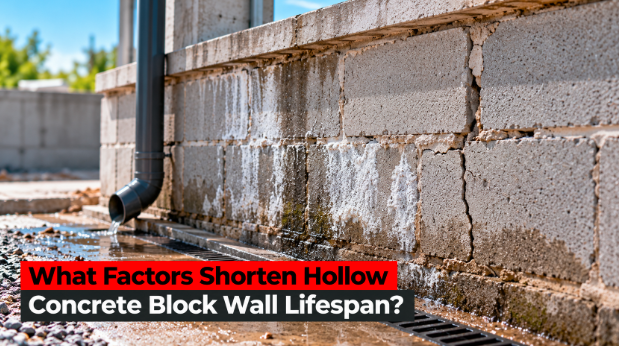
Water penetration is a major cause of masonry maintenance problems.
Rainwater may enter through defective joints, cracks, missing copings, poorly designed openings, or failed wall finishes.
Repeated wetting can contribute to staining, salt deposits, reinforcement corrosion where steel is present, and deterioration of adjacent materials.
In Pakistani monsoon conditions, inadequate drainage can greatly increase water exposure.
2. Poor Mortar Workmanship
Mortar bonds masonry units and helps transfer loads through the wall.
Incorrect mixing, insufficient joint filling, inadequate curing, and poor workmanship can reduce masonry performance.
The correct mortar specification depends on the wall design and exposure.
Contractors should not assume that a stronger cement-rich mortar always delivers a more durable masonry assembly.
Mortar selection should reflect the engineer’s specification and applicable standards, such as ASTM C270 where adopted.
3. Foundation Settlement
Even high-quality hollow blocks cannot prevent damage when foundations settle unevenly.
Differential movement may produce diagonal cracks, separation near openings, and misalignment.
Such damage requires investigation because repairing only the visible plaster does not correct underlying foundation movement.
4. Missing Structural Restraint
Boundary walls and tall partitions require appropriate support against lateral forces.
Depending on the design, the wall may need reinforcement, properly designed columns or piers, ties, anchorage, and movement accommodation.
An unreinforced wall is not automatically unsafe, but its permitted application depends on engineering analysis and applicable building requirements.
5. Uncontrolled Structural Modifications
Cutting large openings, removing supports, or installing heavy equipment without engineering review can compromise an otherwise sound wall.
Property owners should obtain appropriate technical approval before making structural alterations.
Are Hollow Concrete Blocks Better Than Red Clay Bricks for Long-Term Durability?
Neither hollow concrete blocks nor red clay bricks are automatically more durable in every application. Product quality, wall design, moisture detailing, exposure, and workmanship often matter more than the material category alone.
| Factor | Hollow Concrete Blocks | Red Clay Bricks |
| Unit geometry | Larger modules with engineered voids | Generally smaller solid or perforated units |
| Construction joints | Potentially fewer joints per m² | Generally more joints per m² |
| Weight | Depends on dimensions and density | Depends on brick type and density |
| Water resistance | Depends on product and wall detailing | Depends on product and wall detailing |
| Thermal performance | Depends on geometry, density, and finishes | Depends on geometry, material, and finishes |
| Structural use | Subject to specified masonry design | Subject to specified masonry design |
For a 5-marla or 10-marla Pakistani house, block dimensions may reduce the number of individual masonry units required.
However, fewer joints do not automatically mean better structural strength or lower installed cost.
Read PrimeCrete’s residential hollow block wall construction guide for additional planning considerations.
How Can Builders Make Hollow Concrete Block Walls Last Longer?
The most effective durability strategy is to prevent uncontrolled water entry, provide adequate structural support, and follow the approved masonry specifications.
Begin With Correct Material Selection
Determine whether the proposed wall is loadbearing, nonloadbearing, or part of an engineered infill system.
Select the applicable unit strength, dimensions, density, and exposure requirements.
Never substitute a nonloadbearing product for a specified loadbearing unit without engineering approval.
Prepare Stable Foundations
The foundation must safely transfer wall loads to suitable supporting ground.
For boundary walls, consider foundation depth, soil movement, ground drainage, and any additional lateral loading.
Foundation dimensions should follow engineering design rather than a universal rule based only on wall height.
Control Rising Damp
Use appropriate damp-proof detailing where the design requires it.
Avoid bridging damp-proof courses with soil, render, or poorly arranged external paving.
Manage surrounding ground levels so rainwater drains away from vulnerable wall areas.
Protect Wall Tops
Install suitable copings or other approved protective details on exposed walls.
Provide drip edges where appropriate so rainwater does not continuously run down masonry faces.
Wall tops deserve particular attention because horizontal surfaces can collect substantial rainfall.
Use Suitable Movement Joints
Concrete masonry undergoes dimensional changes from temperature and moisture effects.
Designers should provide movement accommodation where required.
Movement joint spacing depends on geometry, openings, restraints, reinforcement, exposure, and the relevant engineering specification.
What Maintenance Do Hollow Block Walls Need?
Routine inspection and timely repair can extend useful wall service life by preventing small defects from developing into more serious problems.
A practical maintenance programme should check:
- Cracks around doors, windows, and wall junctions
- Deteriorated mortar joints
- Failed waterproofing or wall coatings
- Leakage near roof and parapet interfaces
- Corrosion staining
- Loose coping units
- Movement or leaning in boundary walls
- Dampness near ground level
Inspect vulnerable exterior walls after heavy monsoon rainfall and whenever visible movement develops.
Repairs should address the underlying cause rather than covering damage with new plaster.
PrimeCrete’s guide to protecting concrete blocks during storage and handling also explains how poor site practices can create defects before construction begins.
What Should Contractors Check Before Buying Hollow Concrete Blocks?
For a housing development, commercial building, or boundary wall project, request product documentation before ordering.
Important details include unit dimensions, applicable compressive strength, specified standard, density where relevant, water absorption data, and delivery arrangements.
Ask whether the supplied units are suitable for the proposed structural application.
For larger projects, verify representative laboratory test results against the project specification.
A procurement decision based only on the lowest block price may overlook the costs of breakage, dimensional inconsistency, remedial work, and construction delays.
Frequently Asked Questions
Can hollow concrete block walls last 50 years?
Yes, a properly engineered and maintained wall may remain serviceable for 50 years or longer. Actual performance depends on design, exposure, workmanship, and maintenance.
Are hollow blocks suitable for exterior walls?
Yes, when the selected units and completed masonry assembly meet the structural, weather-resistance, and other project requirements.
Do hollow concrete blocks absorb water?
Yes. Concrete masonry is generally porous to some degree. Water absorption varies by material composition, density, manufacturing process, and product specification.
Can hollow concrete blocks support a roof?
Certain loadbearing hollow CMU wall systems can support roof loads when appropriately designed. The unit designation alone does not establish safe roof-bearing capacity.
How often should a hollow block wall be inspected?
Inspect exposed walls periodically and after significant weather events, impact, or suspected movement. Inspection frequency should reflect the building’s risk and maintenance requirements.
Conclusion
The lifespan of hollow concrete block walls depends on far more than the blocks themselves.
Proper foundation design, compliant masonry units, suitable mortar, rainwater protection, and structural detailing all influence long-term performance.
In Pakistan, contractors should pay particular attention to monsoon exposure, damp-proofing, boundary wall stability, and workmanship quality.
PrimeCrete’s hollow concrete masonry products provide an option for projects where engineers require consistent manufactured units backed by suitable product documentation.
