
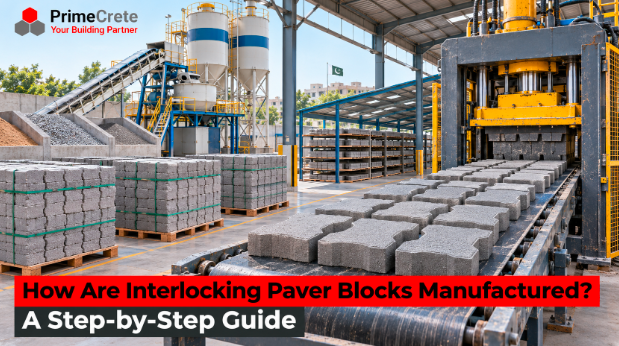
A finished concrete paver looks simple. It has a defined shape, a solid surface, and enough weight to stay in place. Yet producing thousands of blocks with consistent dimensions, density, and strength requires far more than pouring concrete into moulds.
Interlocking paver blocks are manufactured through a controlled process involving raw material selection, concrete batching, mixing, vibro-compaction, demoulding, curing, and quality testing. Each stage influences the finished product.
At PrimeCrete, the concrete-products brand of Pak Dream (Pvt) Ltd, manufacturing takes place at Hattar Industrial Estate in Pakistan using automated MASA Germany technology. The company produces interlocking paver blocks for residential driveways, commercial parking areas, walkways, and infrastructure projects.
Understanding how these blocks are manufactured helps contractors, civil engineers, and procurement teams distinguish properly produced concrete pavers from products with inconsistent quality.
What Are Interlocking Paver Blocks Made Of?
Interlocking paver blocks consist primarily of cement, aggregates, and water. Manufacturers may also incorporate pigments and approved admixtures to achieve particular colours or performance characteristics.
Each ingredient serves a purpose.
- Cement: Acts as the binder that holds the concrete together after hydration.
- Fine aggregates: Sand fills spaces between larger particles and helps achieve a compact mixture.
- Coarse aggregates: Crushed stone provides bulk and contributes to the block’s mechanical properties.
- Water: Activates cement hydration and helps the mixture achieve suitable moulding consistency.
- Pigments: Produce coloured paving surfaces when required.
- Admixtures: Can improve particular properties of the mix, depending on the formulation.
The quality and proportions of these materials matter. Poor aggregate grading, excessive water, or inconsistent cement content can create problems that become visible only after installation.
There is no universal cement-to-sand ratio suitable for every factory-made paver. Manufacturers develop mix designs according to material characteristics, compaction equipment, product requirements, and testing results.
For a closer explanation of how these variables affect durability, see PrimeCrete’s guide to how concrete mix quality affects paver life.
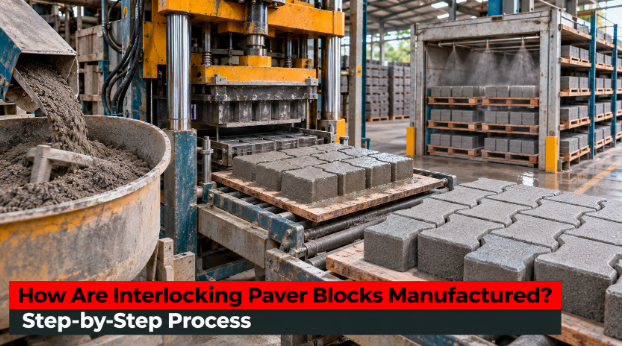
How Are Interlocking Paver Blocks Manufactured? Step-by-Step Process
Modern interlocking paver block manufacturing generally follows eight connected stages.
Step 1: Raw Material Inspection and Preparation
Manufacturing starts before the mixer operates.
Cement, sand, crushed aggregates, and other ingredients must meet the selected production requirements. Aggregates are checked for grading, cleanliness, and excessive moisture variation.
Sand containing too many fine particles may change the mix’s water demand. Inconsistent aggregate grading can also interfere with how tightly the concrete packs inside the mould.
Moisture measurement is particularly important because aggregates may already contain water.
A factory that ignores this moisture could unintentionally change the effective water-cement ratio between batches.
Step 2: Automated Batching
Once the materials are approved, the batching system measures the required quantities according to a production recipe.
Modern plants use weighing equipment and automated controls to manage aggregate, cement, water, and admixture delivery.
Accurate batching reduces variation between production cycles.
For example, when a contractor orders thousands of pavers for a housing society, blocks from different production batches should maintain compatible dimensions and specified properties.
Automated batching supports that consistency, although calibration, material control, and operator supervision remain necessary.
Step 3: Concrete Mixing
The measured ingredients move into a concrete mixer, where they combine into a uniform mixture.
Factory-made pavers commonly use semi-dry or zero-slump concrete, unlike the wetter concrete typically placed in conventional building slabs.
This mixture contains enough water for hydration and compaction but remains sufficiently stiff to retain its shape after moulding.
The mixer must distribute cement, moisture, and aggregates evenly. Insufficient mixing can produce areas with different material concentrations.
Manufacturers must also monitor mixing time and moisture content. More water does not automatically make a stronger paver.
Step 4: Filling the Steel Moulds
The prepared concrete transfers from the mixer to the block-making machine.
A filling system distributes the mixture into mould cavities that define the paving unit’s dimensions and geometry.
Different moulds can produce rectangular, zigzag, I-shaped, and other paving profiles.
The geometry must remain consistent because dimensional differences can create uneven joints during installation.
Steel mould condition also matters. Worn or damaged mould surfaces can affect edges, chamfers, and dimensional accuracy.
Other precast products use different mould designs. For example, concrete grass pavers feature openings for vegetation or suitable infill, while conventional solid pavers provide a continuous paving surface.
Step 5: Vibration and Hydraulic Compaction
This is one of the most important stages of interlocking paver blocks manufacturing.
Inside a modern vibro-press machine, vibration helps rearrange concrete particles while controlled compression consolidates the material.
The process reduces unnecessary voids and helps the concrete form a dense, stable unit.
Two actions work together:
Vibration helps aggregates settle and distribute within the mould.
Compression helps consolidate the stiff mixture to the required dimensions and density.
However, higher pressure does not automatically guarantee better blocks.
Compaction quality also depends on the mix consistency, vibration settings, mould filling, equipment condition, and production cycle.
A poorly proportioned mixture cannot be transformed into a reliable product simply by applying more force.
Step 6: Demoulding and Pallet Transfer
After compaction, the mould releases the freshly formed pavers.
These newly manufactured units are often called green concrete products. They retain their shape but have not yet developed their required hardened properties.
The blocks remain on production pallets and move through a handling system toward the curing area.
This transfer requires care.
Rough movement can damage fresh edges or disturb the surface before adequate strength develops.
Automated handling systems help reduce uncontrolled contact and maintain a repeatable production flow.
Step 7: Controlled Curing
Newly pressed pavers need suitable moisture and temperature conditions for cement hydration to continue.
Curing is not simply drying concrete.
If a green paver loses moisture too quickly, hydration and strength development can suffer.
Industrial facilities may use controlled curing chambers with regulated airflow, temperature, and humidity. Other production arrangements use different approved moisture-retention methods.
The appropriate process depends on the concrete formulation, equipment, required strength, and production conditions.
This stage deserves particular attention in Pakistan, where hot, dry weather can accelerate surface moisture loss.
There is also an important difference between the time required for safe handling, the curing regime, and the age at which a particular strength test is performed.
For a detailed explanation, read how curing affects interlocking paver strength.
Step 8: Quality Inspection, Packaging, and Dispatch
After sufficient curing and strength development, the pavers undergo the applicable quality-control checks.
Manufacturers may examine dimensional consistency, visible defects, density, compressive strength, and water absorption according to project specifications.
Accepted products are stacked, secured, and prepared for transportation.
Proper handling and packaging help protect edges and surfaces during loading, delivery, and unloading.
The manufacturing process ends at dispatch, but the performance of the pavement will also depend on correct storage, installation, and maintenance.
How Are Coloured and Double-Layer Paver Blocks Manufactured?
Some concrete interlocking pavers use two separate concrete layers.
The main or backing layer provides most of the unit’s thickness, while the face layer creates the intended surface appearance and may use a different aggregate grading or colour formulation.
In compatible production systems, the layers are introduced and compacted during the manufacturing cycle to form one paving unit.
Manufacturers can use mineral pigments to achieve red, grey, charcoal, and other finishes.
Colour consistency depends on accurate pigment dosing, material consistency, face-mix thickness, and curing conditions.
A coloured surface should not be treated as proof of higher compressive strength.
Likewise, visible variation in colour does not automatically prove structural failure. Manufacturers should assess appearance and mechanical properties separately.
What Machinery Is Used to Manufacture Paver Blocks?
A commercial production line contains several interconnected systems.
| Equipment | Manufacturing function |
| Aggregate storage and batching system | Stores and measures raw materials |
| Concrete mixer | Produces a uniform concrete mixture |
| Conveyor or bucket transfer | Moves concrete toward the forming machine |
| Filling system and moulds | Determines the product’s shape and dimensions |
| Vibro-press machine | Compacts and forms concrete units |
| Production pallets and handling system | Supports and transports fresh blocks |
| Curing area or chamber | Maintains appropriate curing conditions |
| Quality-testing equipment | Checks specified product characteristics |
| Cubing and packaging equipment | Prepares finished units for dispatch |
The equipment manufacturer MASA Group explains the concrete block and paver production sequence, from aggregate dosing to cubing and dispatch preparation.
Production lines may also manufacture other concrete products using appropriate moulds, mixes, and equipment configurations.
For example, PrimeCrete supplies kerb stone blocks for pavement boundaries and concrete bricks for masonry construction.
Although these products share some manufacturing principles, their geometries, performance requirements, and quality specifications differ.
How Do Manufacturers Check Paver Block Quality?
Visual appearance alone cannot confirm that a paver meets its required specification.
A reliable quality-control programme combines production monitoring with appropriate physical testing.
Compressive Strength
Compressive testing evaluates the unit’s resistance to crushing under a defined testing procedure.
Results must be assessed against the applicable product standard and project requirements.
Water Absorption
Water absorption testing helps assess how much water the concrete unit absorbs under specified test conditions.
Excessive absorption can indicate concerns requiring further investigation, although the result must be interpreted against the correct acceptance criteria.
Dimensional Accuracy
Manufacturers check length, width, and thickness against specified tolerances.
Inconsistent dimensions can make installation difficult and lead to irregular joint widths or uneven paving surfaces.
Visual Inspection
Surface cracks, broken corners, damaged chamfers, segregation, and other defects may indicate manufacturing or handling problems.
A consistent appearance is desirable, but physical testing remains necessary.
For specification guidance, see ASTM C936/C936M-26: Standard Specification for Solid Concrete Interlocking Paving Units.
Projects in Pakistan should identify their required standard and acceptance criteria rather than assume every product automatically conforms to ASTM or a British Standard.
Common Manufacturing Defects and Their Causes
Several defects can originate inside the factory.
| Defect | Possible manufacturing cause |
| Crumbling edges | Weak green strength, poor compaction, or rough handling |
| Irregular dimensions | Worn moulds, filling variation, or equipment issues |
| Surface cracks | Moisture loss, curing problems, or handling stresses |
| Uneven colour | Inconsistent pigment dosing, materials, or curing |
| Excessive surface porosity | Unsuitable mix design or incomplete compaction |
| Face-layer separation | Poor bonding between layers or improper production controls |
These are possible causes, not definitive diagnoses. A damaged paver should be assessed using inspection records and appropriate tests before assigning the cause.
Does Machine Manufacturing Produce Better Pavers?
A controlled automated production line can improve repeatability, especially when producing large quantities.
However, machinery alone is not a quality certificate.
The manufacturer must still control raw materials, equipment settings, curing, testing, and product handling.
Similarly, not every hand-cast product has identical performance.
The important distinction is whether the finished unit meets its specified requirements.
For a dedicated comparison of production methods, see Machine-Made vs Hand-Made Paver Blocks.
What Should Buyers in Pakistan Check Before Ordering?
Contractors and developers should request evidence of product quality rather than relying solely on sample appearance.
Important purchasing questions include the proposed dimensions and thickness, specified performance standard, available test reports, production consistency, and delivery arrangements.
For projects involving parking areas or vehicle traffic, the pavement design must also consider anticipated loading, jointing, bedding material, base construction, and drainage.
Even a properly manufactured paver can perform poorly over an unsuitable foundation.
PrimeCrete manufactures concrete paving products at Hattar Industrial Estate in Khyber Pakhtunkhwa. Project teams can discuss the relevant product specifications and order requirements before procurement.
Frequently Asked Questions
1. How are interlocking paver blocks made?
Interlocking paver blocks are made by batching and mixing concrete materials, filling steel moulds, compacting the mixture using vibration and compression, removing the formed blocks, curing them, and completing quality inspections.
2. Which concrete mix is used for paver block manufacturing?
Machine-pressed pavers commonly use a stiff, semi-dry concrete mix. The exact proportions depend on the materials, equipment, product specifications, and verified mix design.
3. Why is vibration used when manufacturing pavers?
Vibration helps concrete particles settle and rearrange inside the mould. Combined with compression, it helps achieve the intended compaction and unit geometry.
4. How long does it take to manufacture interlocking paver blocks?
The forming cycle in an automated machine can be relatively short, but total production time includes mixing, forming, curing, testing, and packaging. It varies by plant and product, so no single duration applies to every manufacturer.
5. Are thicker paver blocks automatically stronger?
No. Thickness influences application suitability, but concrete strength and durability also depend on the mix, compaction, curing, and verified product properties.
Conclusion
Manufacturing reliable interlocking paver blocks involves more than achieving the right shape.
Every step, from aggregate inspection and accurate batching to vibro-compaction and controlled curing, contributes to the consistency of the finished unit.
For Pakistani contractors and developers, understanding these stages makes it easier to ask suppliers meaningful questions and evaluate manufacturing quality.
At PrimeCrete, automated MASA Germany manufacturing technology supports the production of concrete paving and masonry products for a range of construction applications.
Planning a driveway, commercial parking area, housing development, or infrastructure project? Explore PrimeCrete’s interlocking paver products and contact the team to discuss dimensions, performance requirements, and project quantities.
