
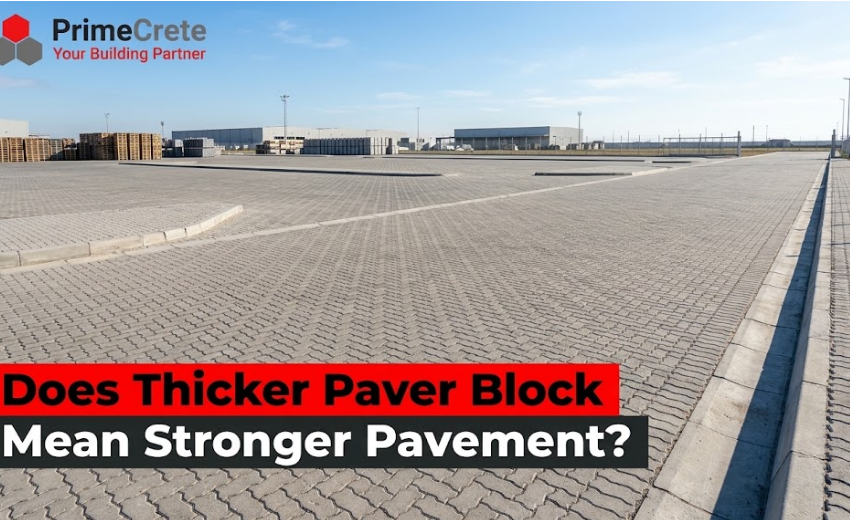
A widespread misconception across Pakistan’s construction sector is that a thicker unit automatically creates a stronger surface. When property developers, municipal engineers, and residential homeowners choose an exterior surface, they often assume that jumping from a 60 mm block to an 80 mm block guarantees against cracks, sinking, and rutting. At PrimeCrete, we manufacture high-performance precast products using automated German compaction systems, and field data consistently proves this assumption wrong: thickness alone does not make a pavement stronger.
While thickness is essential for resisting horizontal shear, the true durability of your paved area depends on material compressive strength, interlocking friction, and subgrade foundation prep. Laying a low-density 80 mm paver block over uncompacted soil will fail significantly faster than laying a properly engineered 60 mm interlocking paver block over a compacted, well-draining base.
The Engineering Truth: Thickness vs. Compressive Strength
To understand how a paver block performs under load, one must separate material strength from systemic structural load dispersion.
1. Compressive Strength (PSI) is in the Concrete Mix, Not the Height
The actual load-carrying capacity of the concrete material is measured in pounds per square inch (PSI) or MegaPascals (MPa). Compressive strength is determined by:
- The water-cement ratio
- Aggregate density and mechanical grading
- Vibro-compaction tonnage during casting
- Complete hydration during the curing cycle
As outlined in our guide on how concrete mix quality affects paver life, international standards like ASTM C936 (Standard Specification for Solid Concrete Interlocking Paving Units) establish a minimum average compressive strength of 8,000 PSI (55 MPa).
If a local roadside vendor casts an 80 mm block with poor sand, excessive water, and manual tamping, that block may only reach 2,500 to 3,000 PSI. Under a heavy SUV or delivery truck, that thick block will crush and crumble. In contrast, an automated 60 mm paver block engineered to 7,000+ PSI will bear vertical wheel weights without surface degradation.
2. What Thickness Actually Does: Horizontal Shear Resistance
If thickness doesn’t dictate compressive strength, why do thicker pavers exist?
Thickness controls aspect ratio and rotational stability. When a vehicle brakes, accelerates, or turns, it exerts lateral (frictional) forces across the surface. A 50 mm block under heavy braking torque can rotate or tilt, biting into the bedding sand and displacing adjacent joints. An 80 mm or 100 mm unit provides deep vertical joint faces, generating friction against adjacent blocks to keep the system flat under turning truck axles.
Why Strong Paver Blocks Still Sink (The Foundation Factor)
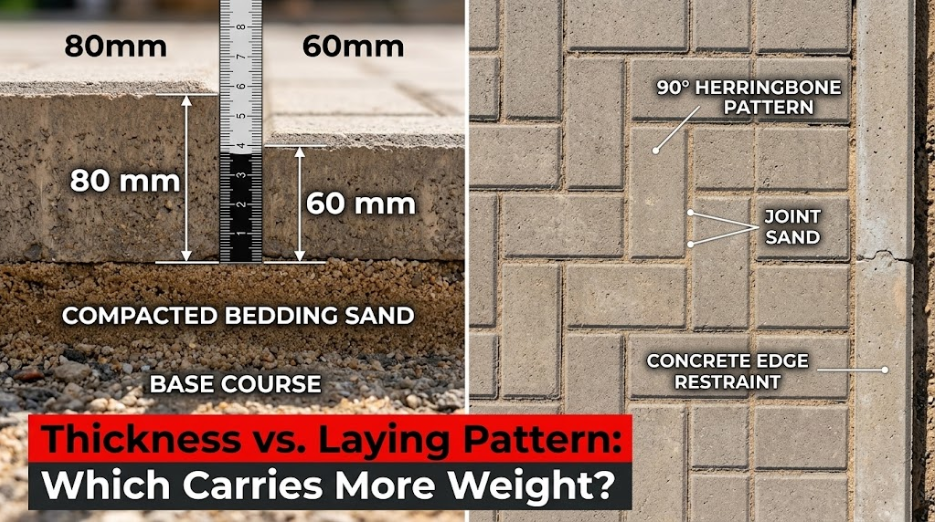
When homeowners in Lahore, Islamabad, or Karachi complain that their “tuff tiles are sinking,” the issue is almost never the thickness of the block. A flexible paver block pavement is an integrated, multi-layered system:
- Subgrade Soil (Compacted Formation): Natural soil must be cleared of organic matter and rolled to a high California Bearing Ratio (CBR). If foundation soil softens under seasonal moisture, the entire pavement settles regardless of paver thickness.
- Sub-Base & Base Course: High-traffic pavements require 150 mm to 300 mm of crushed aggregate or Water-Bound Macadam (WBM) according to National Highway Authority (NHA) General Specifications. This foundation layer bears and dissipates wheel weights downward.
- Bedding Sand (25 mm to 40 mm): Must be clean, coarse, angular sand—never fine river/plaster silt (ravi sand), which washes out and causes rutting under rainfall.
- Jointing Sand: Sand locked into the 2–3 mm gaps acts as a load-transfer mechanism between blocks.
- Edge Restraints: Without rigid kerb stone blocks pinned along perimeters, the blocks push laterally outward over time, breaking interlock and allowing rainwater to undermine the base.
Thickness vs. Laying Pattern: Which Carries More Weight?
Before upgrading block thickness, analyze your laying arrangement. Laying geometry frequently contributes more to pavement resistance than an extra 20 mm of concrete.
In our analysis of the best paver block pattern for car parking, field testing shows that a 45° or 90° Herringbone pattern provides higher resistance to braking and turning loads than standard stretcher (running) bond. Stretcher bond contains long continuous seams that creep along the direction of traffic.
A 60 mm paver block laid in a 45° herringbone pattern interlocks across four axes, resisting traffic forces better than an 80 mm block laid in a linear running bond.
Application Guide: Selecting the Right Thickness in Pakistan
Over-specifying paver thickness inflates project transport and unit costs without delivering practical advantages. Use this engineering matrix to select the appropriate paver block for your application:
| Paver Thickness | Target Compressive Strength | Recommended Applications | Axle Load Rating |
| 50 mm (2 in) | 4,000 – 5,000 PSI | Footpaths, garden paths, rooftop patios, jogging tracks | Pedestrian traffic only |
| 60 mm (2.4 in) | 5,000 – 7,000+ PSI | Home driveways, car porches, residential society streets, office parking bays | Light-to-medium vehicles (Cars, SUVs, delivery vans) |
| 80 mm (3.15 in) | 7,000 – 8,000+ PSI | Commercial plazas, petrol pumps, bus terminals, heavy delivery routes | Heavy commercial vehicles (Tankers, multi-axle trucks) |
| 100 mm (4 in) | 8,000+ PSI | Container terminals, dry ports, industrial storage yards | Extreme point & dynamic axle loads |
For projects balancing structural performance with structural load-bearing requirements on perimeter walls, pairing these surfaces with factory-tested solid concrete blocks ensures uniform masonry standards across the entire development.
Local Environmental Vulnerabilities in Pakistan
A thick paver will still deteriorate if it is not manufactured to withstand regional environmental conditions:
- Sulfate Attack and Kallar: High-salinity subsoils common in rural Punjab and coastal Sindh draw salts upward via capillary action. Pavers with high water absorption (>5%) absorb this moisture, leading to severe efflorescence, internal crumbling, and surface spalling.
- Monsoon Inundation: Poor surface slopes trap standing water over joints. Unsealed joints allow water to seep into the bedding sand, fluidizing it and causing pavers to rock and fracture under traffic. Understanding the differences detailed in our paver block and interlocking tiles comparison guide helps buyers differentiate dense, low-absorption precast blocks from porous, decorative tiles.
The Verdict
Does a thicker paver block mean a stronger pavement?
Not on its own. Thickness provides essential joint friction and lateral resistance to stop blocks from tipping under heavy turning wheels, but the pavement’s overall load capacity depends on:
- High-compression concrete mixes (minimum 5,000 to 8,000 PSI)
- A properly excavated, graded, and compacted sub-base
- Interlocking laying patterns like 45° herringbone
- Concrete kerb stone blocks to lock lateral borders
For standard residential driveways and car parking across Pakistan, a high-density 60 mm paver block is structurally sound and budget-efficient. Reserve 80 mm and 100 mm units for petrol pumps, warehouses, and industrial transport corridors where heavy axle loads require enhanced shear resistance.
